
What Reconstitution Means
Lyophilized peptides are supplied as dry powder because many peptide molecules are more stable in that form than in solution.
Reconstitution means adding the exact diluent specified for a particular product so the powder becomes a measurable liquid solution. The correct diluent, concentration, handling method, storage temperature, and beyond-use period vary by product.
Safety Comes Before Technique
Do not proceed when the label is missing, the vial is damaged, the powder looks unusual, the expiration date is unclear, or the specified diluent is unavailable. When in doubt, contact the dispensing pharmacy or prescribing clinician.
Supplies Commonly Referenced in Official Instructions
Product-specific setup
Labeled vial containing lyophilized product, specified diluent, appropriate measuring syringe, alcohol swabs, and a clean disposable work surface.
Record before handling
Manufacturer or pharmacy instructions, calculator, marker and label, storage date, concentration record, and sharps container when applicable.
 Sponsored / AffiliatePeptide ReGenesis · Peptide education, protocols, and wellness-focused resources
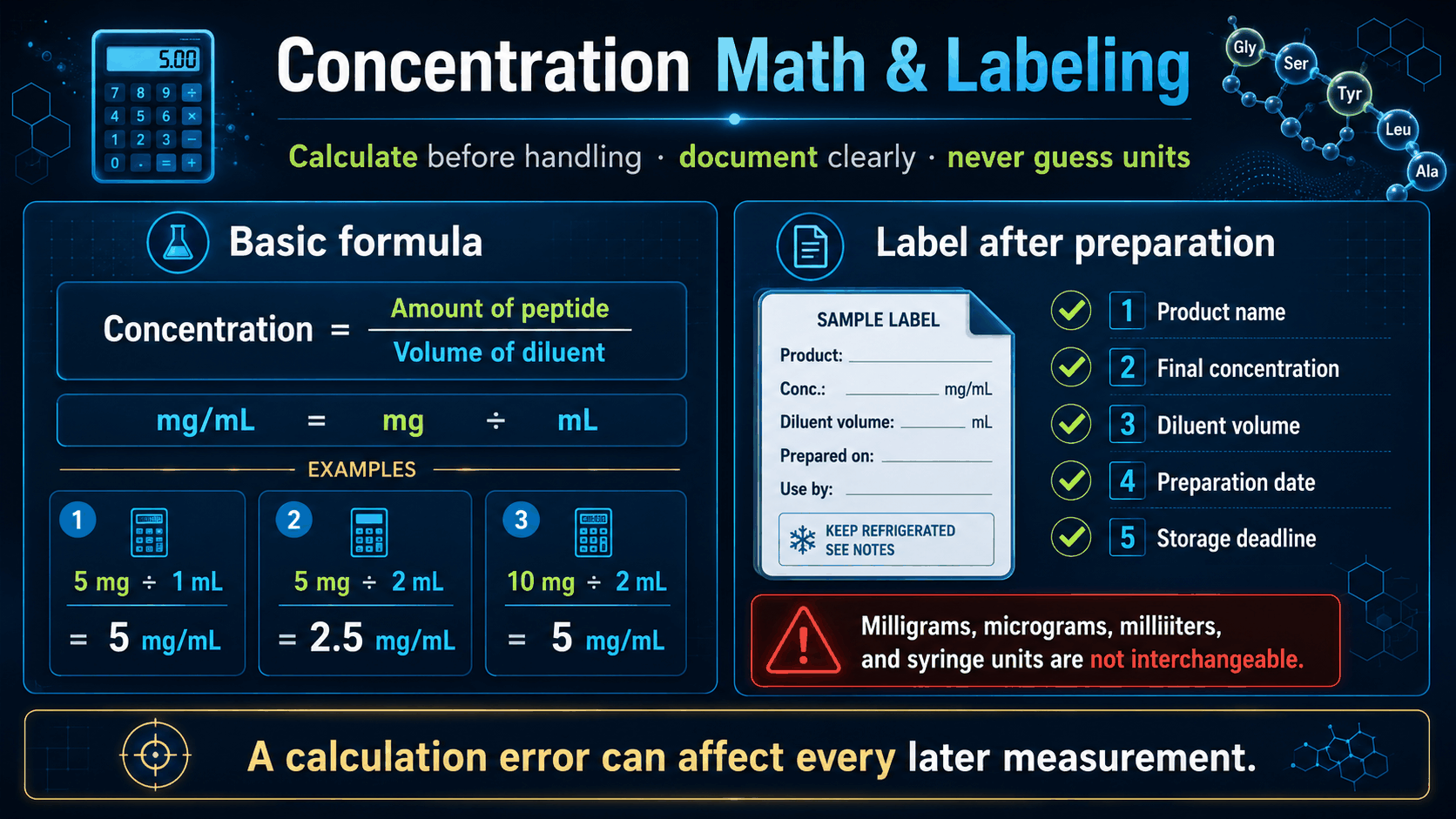
Understanding Concentration Math
Concentration tells you how much peptide is present in each milliliter of solution. The arithmetic should be completed and independently checked before any product is handled.
| Diluent volume | Concentration for a 5 mg vial | Amount in 0.1 mL |
|---|---|---|
| 1 mL | 5 mg/mL | 0.5 mg |
| 2 mL | 2.5 mg/mL | 0.25 mg |
| 5 mL | 1 mg/mL | 0.1 mg |
| 10 mL | 0.5 mg/mL | 0.05 mg |
These examples demonstrate arithmetic only. They are not product or dosing recommendations.
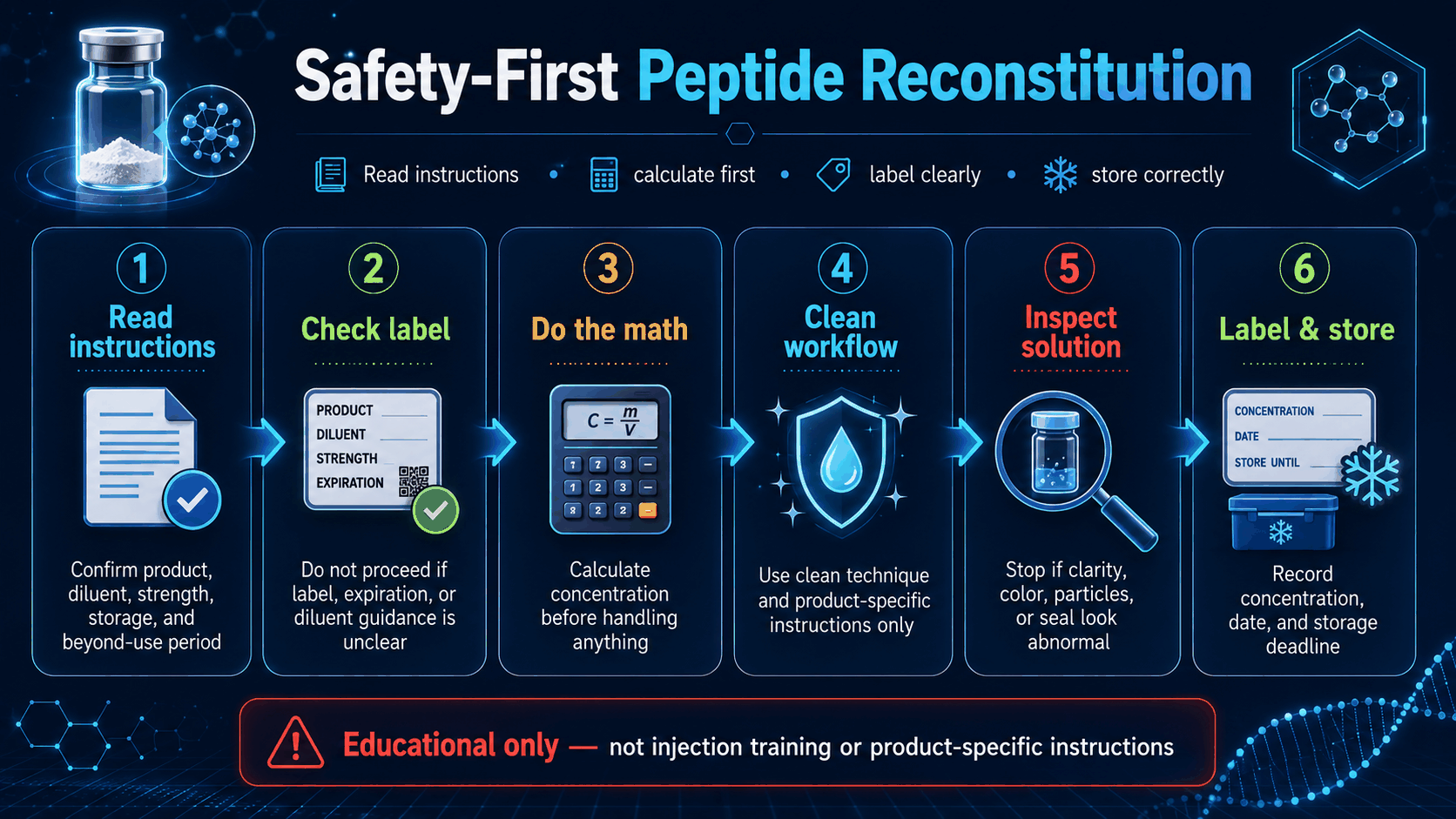
A Seven-Step Educational Workflow
Measuring a Volume From the Prepared Solution
Any later measurement depends on the confirmed concentration. The product instructions or prescribing clinician should specify the intended volume and the appropriate syringe.
Injection route, needle selection, site, dose, and administration technique are patient- and product-specific and should be taught by a qualified healthcare professional.
Common Reconstitution Mistakes
Using the wrong diluent
Different products may require different diluents. Never substitute based on an online protocol.
Skipping the calculation
A concentration error changes every later measurement. Write down and verify the math first.
Shaking aggressively
Some formulations can be damaged by vigorous agitation. Follow official handling instructions.
Guessing storage time
Storage temperature and beyond-use dating must come from the label, pharmacy, or manufacturer.
Frequently Asked Questions
Is bacteriostatic water always correct?
No. Use only the diluent specified for the exact product.
Can every lyophilized peptide be gently rolled?
Not necessarily. Follow the official instructions for mixing and agitation.
How long does a reconstituted vial last?
It varies. Use the manufacturer or pharmacy beyond-use instructions, not a universal online rule.
Can a cloudy solution still be used?
Only when cloudiness is described as normal in the official product information. Otherwise, do not use it and contact the pharmacy.
 Sponsored / AffiliateApollo Peptide Sciences · Research-focused peptide science and molecular data
Key Takeaways
- Read product-specific instructions first.
- Confirm the exact diluent and final concentration.
- Complete and double-check the math before handling the vial.
- Use clean technique and avoid unnecessary agitation.
- Inspect, label, and store the solution exactly as directed.
- Do not self-administer unapproved or research-only peptides.