
Why Beginners Make the Same Peptide Mistakes
Most mistakes come from treating every peptide product as if it were the same kind of thing.
A cosmetic serum, collagen powder, prescription medicine, and research-only vial have completely different evidence, regulation, storage, dosing, and safety requirements. The safest beginner habit is to slow down and define the category before making decisions.
First, Know the Product Category
Skincare peptide
Usually evaluated by ingredient list, irritation, formulation, consistency, and cosmetic expectations.
Supplement
Usually evaluated by nutrition context, product quality, serving amount, source, and label transparency.
Prescription medicine
Requires qualified medical care, legal prescribing, monitoring, and product-specific instructions.
Research-only material
Not intended for personal use. Treat as a legal and safety red flag for consumers.
The Complete List: 10 Mistakes and Safer Alternatives
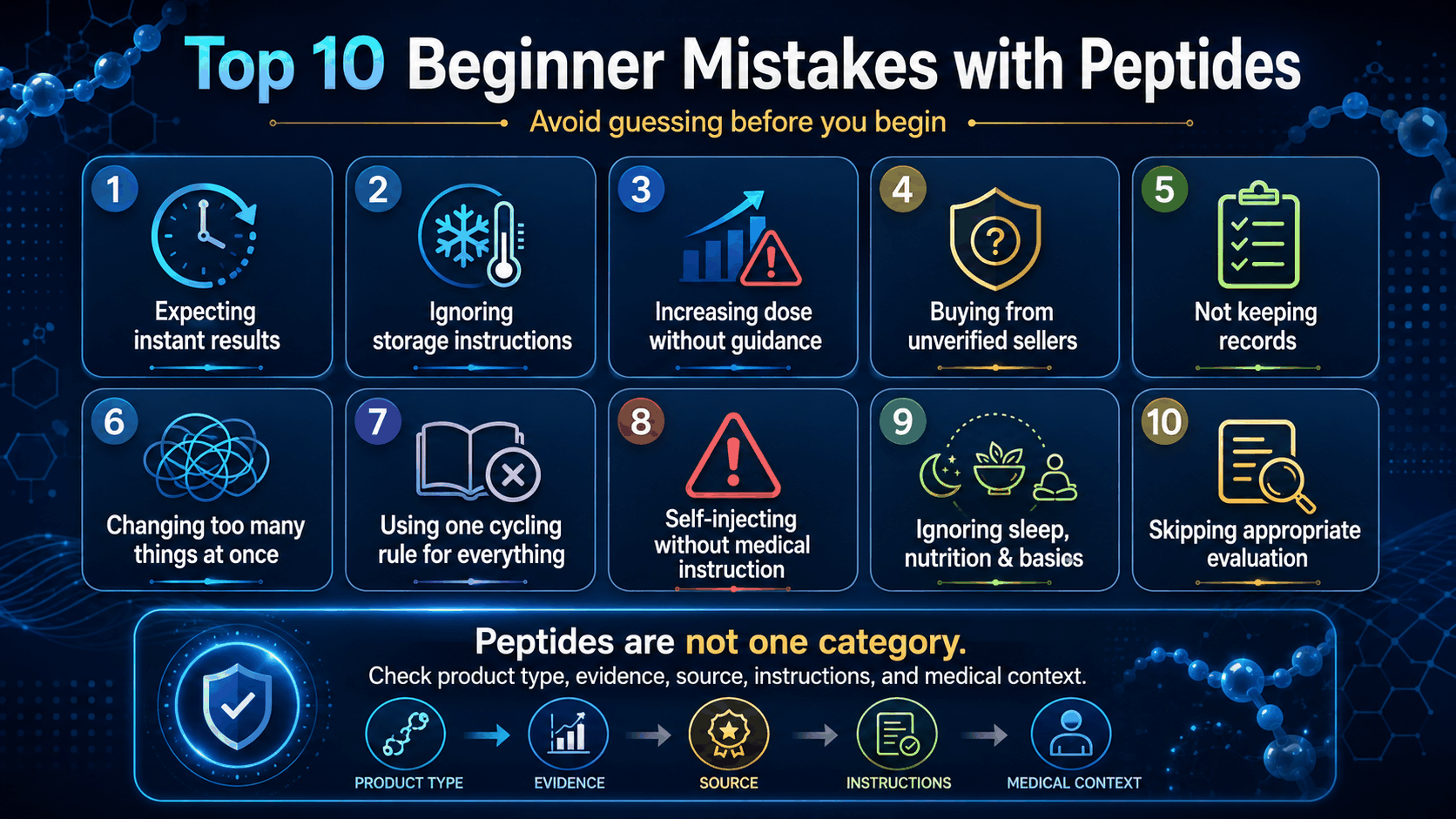
Expecting results in one week
Biological and cosmetic changes often take weeks or months, not days.
Ignoring storage instructions
Heat, light, moisture, or temperature swings can affect some peptide products.
Increasing the dose without guidance
More is not automatically more effective — and may create more risk.
Buying from an unverified seller
A polished website or PDF certificate does not prove identity, purity, or legal status.
Not keeping records
Memory is unreliable when multiple variables change over time.
Changing too many things at once
If five variables change together, you cannot identify what helped or caused a problem.
Applying one cycling rule to everything
There is no universal “four weeks on, two weeks off” rule for all peptides.
Self-injecting without medical instruction
Injection involves sterility, correct identity, route, dose, disposal, and complication recognition.
Ignoring the bigger health context
No peptide replaces sleep, nutrition, rehabilitation, sunscreen, or evidence-based treatment.
Skipping appropriate evaluation
Prescription and systemic peptide therapies require product-specific medical monitoring.
 Sponsored / AffiliateQuest Health · Personal lab testing and health marker tracking
Important Safety Note
Injectable products raise risks that do not apply to ordinary topical skincare. Sterility, correct identity, route, dose, disposal, contraindications, and complication recognition all matter.
A Five-Question Peptide Checklist
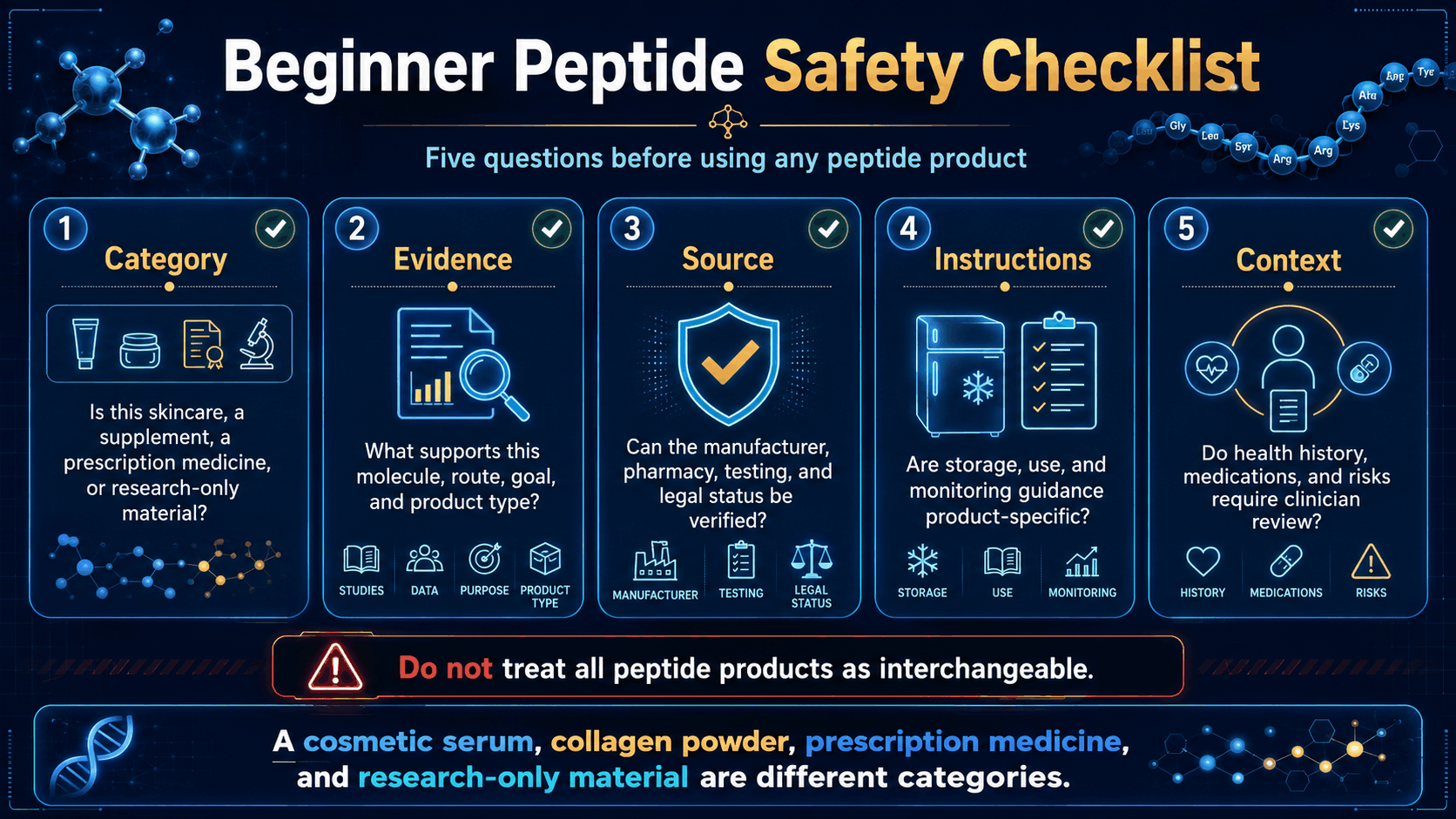
Is this skincare, a supplement, a prescription medicine, or research-only material?
What evidence supports this exact molecule, route, dose, and goal?
Can the manufacturer, pharmacy, testing, and legal status be verified?
Are storage, use, and monitoring guidance product-specific?
Do health history, medications, and risks require clinician review?
Frequently Asked Questions
How long should I wait before judging a peptide product?
It depends on the exact product and endpoint. Cosmetic appearance, nutrition outcomes, and prescription therapies all use different timelines.
Should all peptides be refrigerated?
No. Follow the storage instructions for the exact product. Some need refrigeration; others should be stored at controlled room temperature and protected from light or moisture.
Is a Certificate of Analysis enough to trust a seller?
No. A CoA is only useful when the batch, testing laboratory, methods, and connection to the actual product can be verified.
Can I combine several peptide products?
Combining products can make it harder to identify benefits, irritation, interactions, or adverse effects. Prescription combinations require clinician guidance.
Do topical cosmetic peptides require medical tests?
Usually not. Monitoring generally focuses on irritation, allergy, photos, and consistent skincare conditions. Prescription and systemic therapies are different.
 Sponsored / AffiliateMito Red Light · Red light therapy devices for recovery and wellness routines
Key Takeaways
- Do not treat all peptide products as interchangeable.
- Set realistic timelines and track results consistently.
- Follow product-specific storage and use instructions.
- Verify seller, testing, manufacturer, pharmacy, and legal status when relevant.
- Do not self-inject prescription, unapproved, or research-only peptides based on internet instructions.