
Why Peptide Labels Are Confusing
The front of a skincare bottle can be marketing. The ingredient list is the better translation tool.
Words like “Peptide Complex,” “Youth Matrix,” or “Advanced Peptide Technology” may sound scientific, but they do not tell you which peptide is present or how meaningful the formula is. The INCI list gives more useful clues.
INCI Basics: What to Look For First
INCI stands for International Nomenclature of Cosmetic Ingredients. It helps you compare formulas across brands and countries using standardized ingredient names.
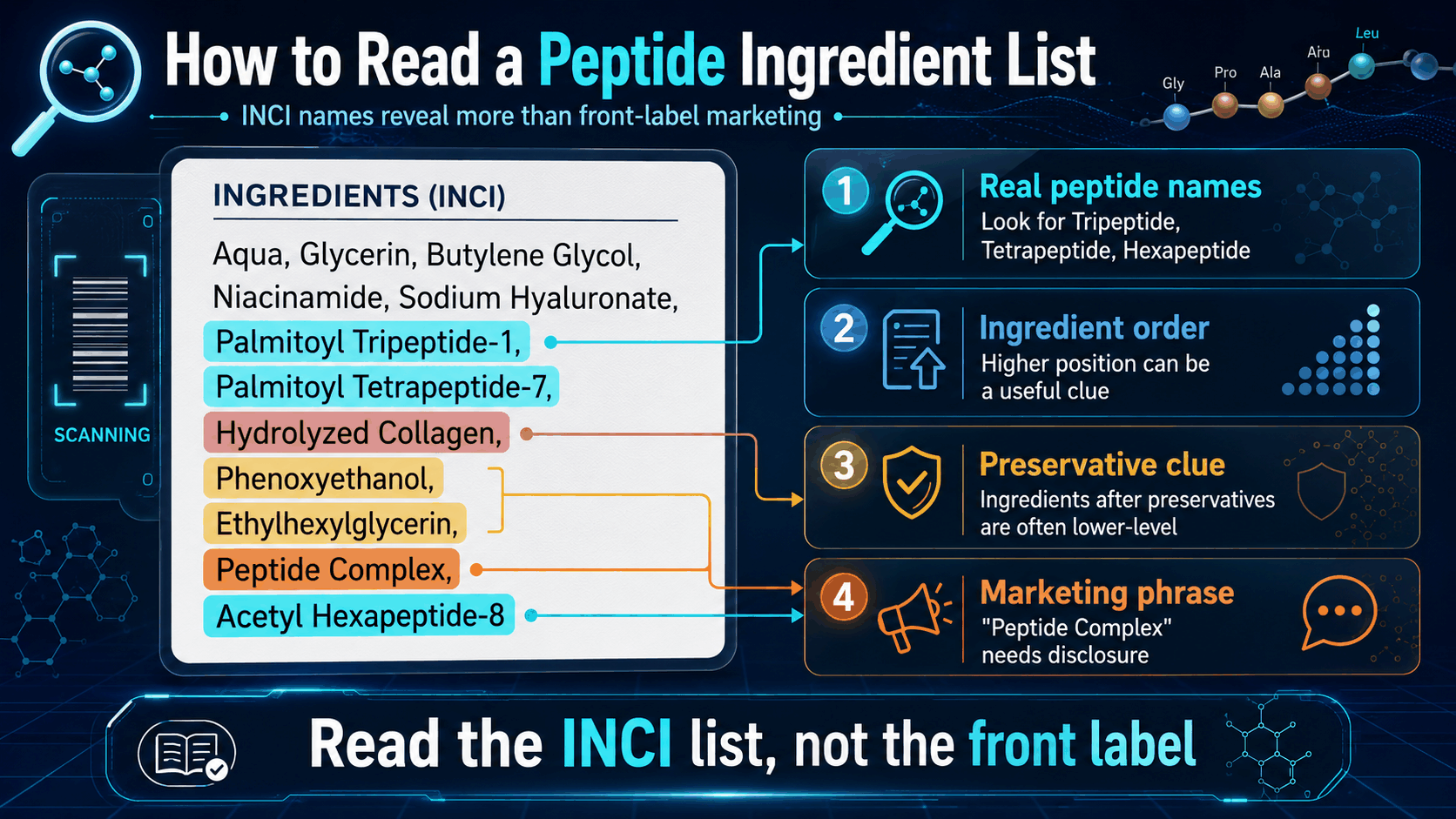
Ignore the headline
Names like “Peptide Complex Pro” are marketing. The INCI list is more informative than the front label.
Find real names
Look for Tripeptide, Tetrapeptide, Hexapeptide, Palmitoyl, Acetyl, or Copper Tripeptide-1.
Use order carefully
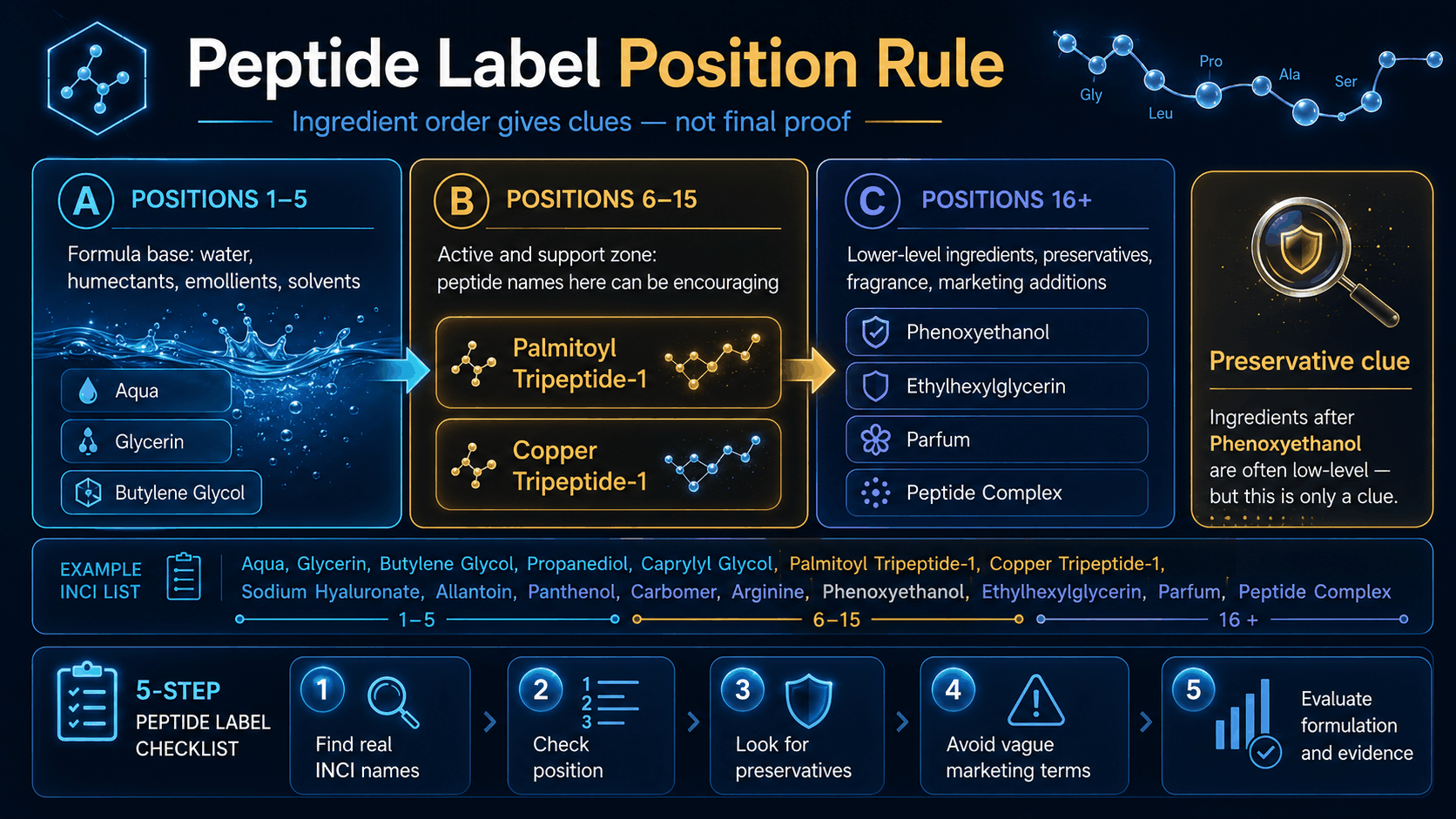
Ingredient order gives useful clues, but it does not reveal exact percentages or prove clinical effectiveness.
The Position Rule: Divide the INCI List Into Three Zones
Zone A · 1–5
The formula base: water, emollients, humectants, solvents, and thickeners. These usually dominate the product.
Zone B · 6–15
Active and supporting ingredients often appear here. A peptide in this zone can be encouraging, but still does not confirm dose.
Zone C · 16+
Lower-level ingredients, preservatives, fragrance, colorants, and sometimes marketing additions.
 Sponsored / AffiliatePeptide University · Peptide learning resources and educational programs
Common Peptide Names You May See in Skincare
| INCI name | Common name | Typical purpose | How to read it |
|---|---|---|---|
| Palmitoyl Tripeptide-1 | Part of Matrixyl systems | Collagen-support formulations | Recognized cosmetic peptide |
| Palmitoyl Tetrapeptide-7 | Part of Matrixyl 3000 | Anti-aging formulations | Recognized cosmetic peptide |
| Acetyl Hexapeptide-8 | Argireline | Expression-line appearance | Recognized cosmetic peptide |
| Copper Tripeptide-1 | GHK-Cu | Repair and skin conditioning | Recognized cosmetic peptide |
| Palmitoyl Tripeptide-5 | Syn-Coll | Collagen-support claims | Recognized cosmetic peptide |
| Hydrolyzed Collagen | Hydrolyzed collagen | Surface conditioning | Not the same as a signaling peptide |
| Collagen | Native collagen | Film-forming and conditioning | Large intact protein |
| “Peptide Complex” | Marketing phrase | Unknown without disclosure | Not informative by itself |
Demo: How to Analyze a Sample Peptide Serum
Peptide Youth Serum
Aqua, Glycerin, Butylene Glycol, Niacinamide, Sodium Hyaluronate, Pentylene Glycol, Palmitoyl Tripeptide-1, Palmitoyl Tetrapeptide-7, Carbomer, Sodium Hydroxide, Allantoin, Hydrolyzed Collagen, Phenoxyethanol, Ethylhexylglycerin, “Peptide Complex”, Acetyl Hexapeptide-8, Parfum, CI 42090
What this label suggests
The base is moisturizing, two recognized peptides appear before the preservative, hydrolyzed collagen is mainly surface-conditioning, and the late “Peptide Complex” term needs more disclosure.
Three Marketing Claims Worth Questioning
Myth #1: More peptide words on the package mean more peptides in the formula.
Fact: Product names are marketing. The INCI list is more informative than the front label.
Myth #2: “Peptide Complex” guarantees several powerful peptides.
Fact: It is not a specific INCI name. Without disclosure, it tells you very little.
Myth #3: Concentration does not matter as long as the peptide is present.
Fact: Presence alone does not guarantee a measurable effect. Formula, dose, stability, and evidence all matter.
How to Read Collagen and Peptide Supplement Labels
Frequently Asked Questions
Does a peptide after Phenoxyethanol mean it cannot work?
No. It usually indicates a low concentration, but some peptides are intentionally used at low levels. Ingredient order alone is not enough to judge effectiveness.
Is Hydrolyzed Collagen a cosmetic peptide?
It is a mixture of smaller collagen fragments used mainly for surface conditioning and moisturization. It is not the same as a defined signaling peptide such as Copper Tripeptide-1.
What does “Peptide Complex” mean?
By itself, very little. It is a marketing phrase unless the brand also lists individual INCI names and meaningful formulation details.
Are plant collagen products real collagen?
Plants do not naturally produce collagen. Such products usually contain nutrients or extracts marketed to support the body’s own collagen production.
 Sponsored / AffiliateTeleWellnessMD · Telehealth wellness consultations and health optimization support
Key Takeaways
- The INCI list is more useful than front-label peptide marketing.
- Recognized peptide names often include Tripeptide, Tetrapeptide, Hexapeptide, Palmitoyl, Acetyl, or Copper Tripeptide-1.
- Ingredient position is a clue, but it does not reveal exact percentage or prove effectiveness.
- Hydrolyzed collagen is not the same as a defined signaling cosmetic peptide.
- “Peptide Complex” is not informative unless individual ingredients are disclosed.