
Why Peptides and Proteins Are Easy to Confuse
Peptides and proteins are made from the same basic material: amino acids.
The practical difference is scale and behavior. Peptides are generally shorter chains and often discussed as signals or regulators. Proteins are generally longer chains and often act as structural components, transporters, enzymes, or complex biological machinery.
The Core Difference: Same Material, Different Scale
Both peptides and proteins are chains of amino acids connected by peptide bonds. The difference is mostly length, folding, and biological role.
Amino acids
Both peptides and proteins are made from amino-acid building blocks.
Short vs long
Peptides are usually shorter. Proteins are longer and may contain hundreds or thousands of amino acids.
Signal vs structure
Peptides often communicate or regulate. Proteins often build, transport, catalyze, and support.
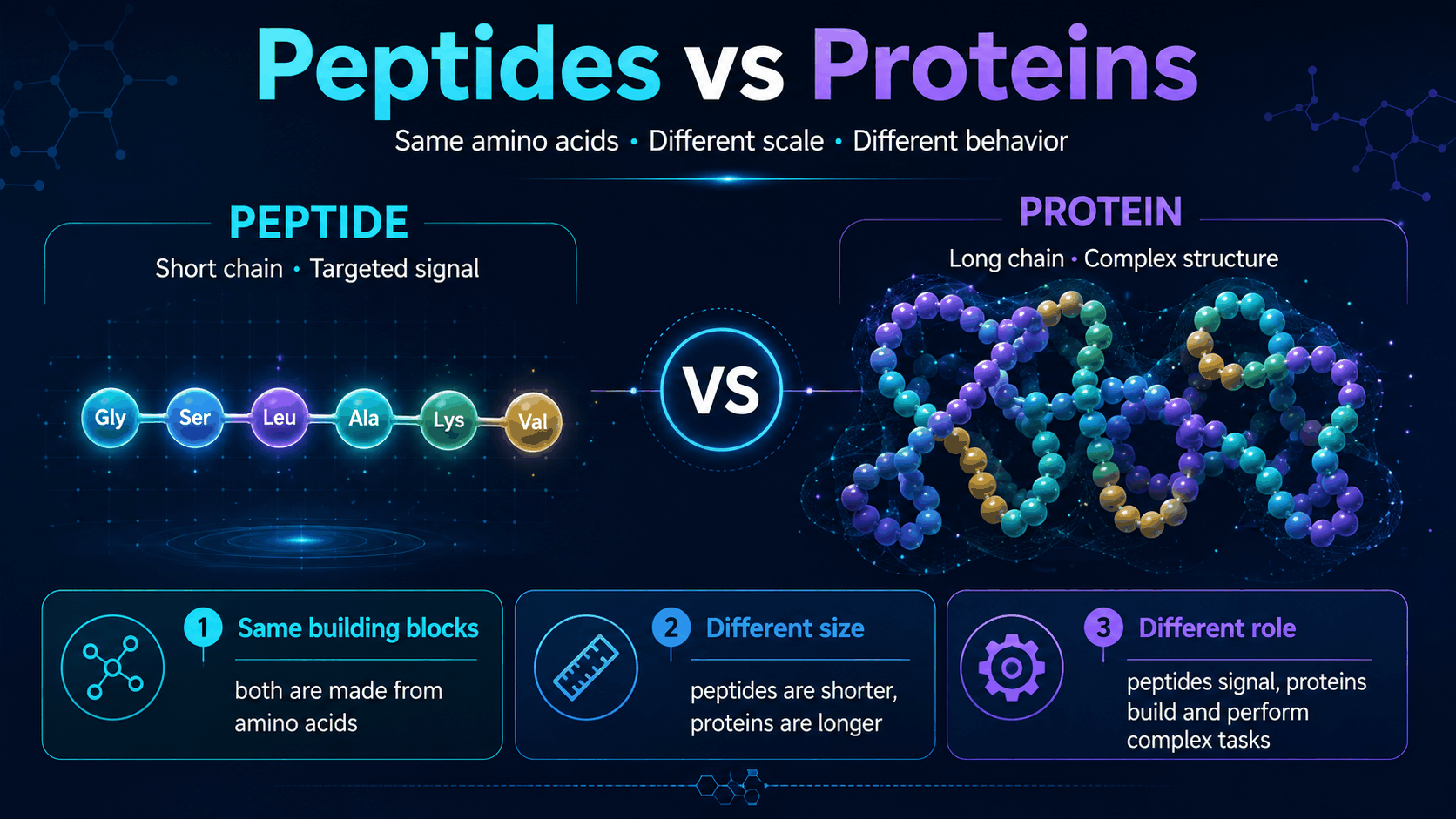
Protein Builds. Peptide Signals.
Builds and supports
Proteins form tissues, transport molecules, catalyze reactions, and perform complex mechanical or structural work.
Controls and signals
Many peptides act as short biological messages that influence receptors, hormones, neurotransmission, or cell behavior.
 Sponsored / AffiliateApollo Peptide Sciences · Research-focused peptide science and molecular data
Proteins Can Become Complex 3D Machines
Longer chains can fold into multiple levels of structure. This folding is essential to many protein functions.
Why Molecular Size Changes the Journey
Proteins and peptides can be processed differently in digestion and formulation. Exact behavior depends on the molecule, sequence, formulation, and delivery route.
Mostly broken down
A large protein is typically digested into amino acids and smaller peptides before absorption.
Context matters
Some short peptide fragments may retain biological activity depending on sequence and formulation.
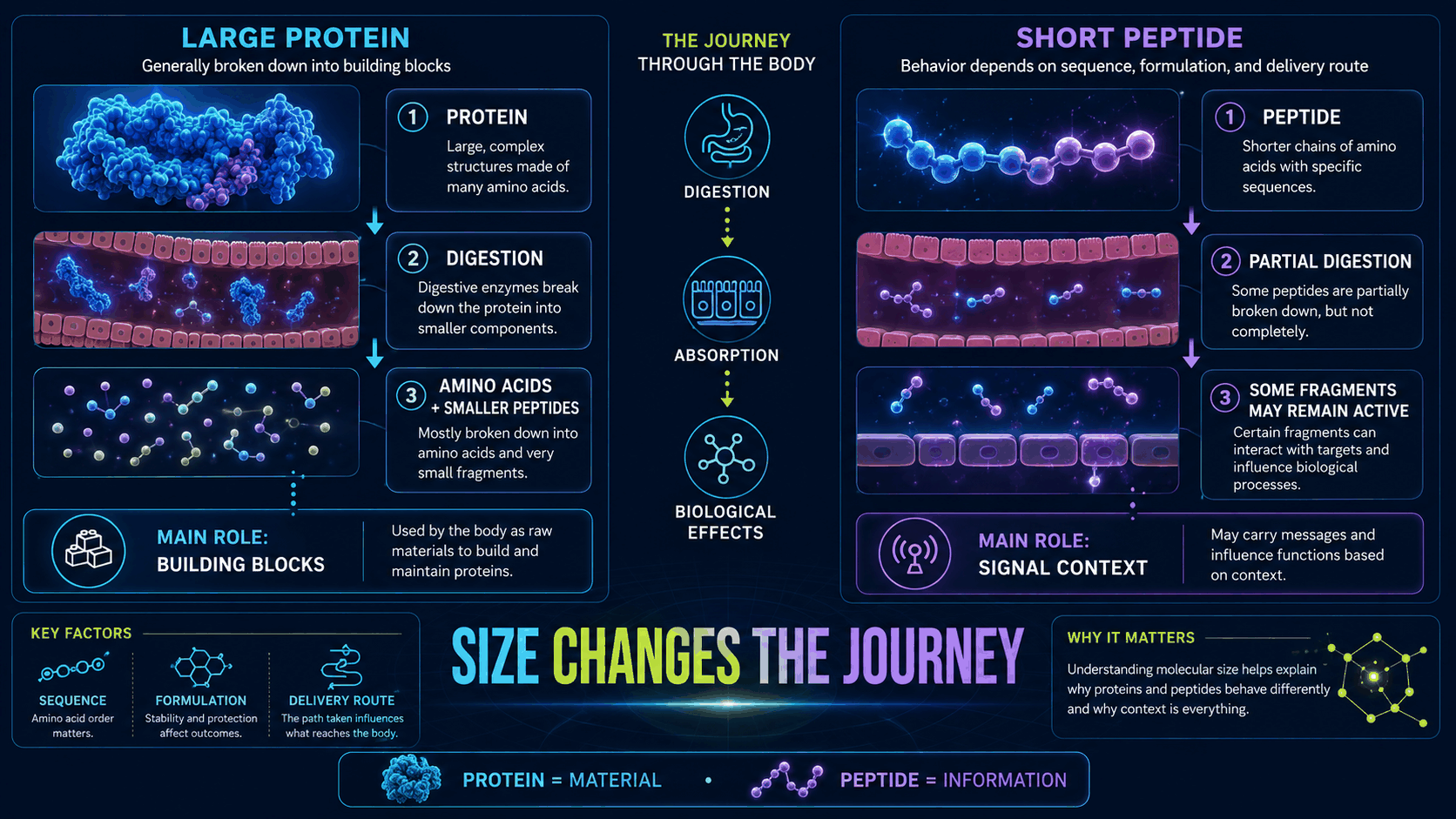
Peptide vs Protein Comparison Table
| Parameter | Peptide | Protein |
|---|---|---|
| Chain length | Often 2–50 amino acids | Usually longer than 50 amino acids |
| Molecular weight | Generally lower | Generally much higher |
| Main role | Signaling, regulation, instruction | Structure, transport, catalysis, mechanics |
| 3D structure | Often simpler | Frequently complex and highly folded |
| Topical delivery | Depends on size and formulation | Large intact proteins penetrate poorly |
| Oral digestion | Many are broken down; some fragments may remain active | Mostly digested into peptides and amino acids |
| Examples in the body | Oxytocin, endorphins, signaling peptides | Collagen, actin, hemoglobin, enzymes |
| Common products | GHK-Cu, Matrixyl, peptide therapeutics | Whey protein, casein, collagen |
Three Common Misconceptions
Myth #1: If you drink collagen, it goes directly to your skin.
Fact: Collagen is digested into amino acids and smaller peptides. The body receives building blocks, not an intact collagen molecule delivered straight to the skin.
Myth #2: A peptide is just expensive protein.
Fact: Peptides and proteins can have different roles. Protein often acts as building material; many peptides act as biological signals.
Myth #3: All peptides are the same.
Fact: Amino-acid sequence determines function. Different peptides can interact with different targets and pathways.
Frequently Asked Questions
Is collagen a peptide or a protein?
Intact collagen is a large structural protein. “Collagen peptides” are smaller fragments produced by hydrolyzing collagen.
Is insulin a peptide or a protein?
Insulin contains 51 amino acids and is often called a peptide hormone, although it sits near the conventional boundary between peptides and small proteins.
Can peptides pass through the skin?
Some may interact with or cross the skin barrier more effectively than large proteins, but penetration depends on molecular size, charge, formulation, and delivery technology.
Are peptide supplements better than protein?
They serve different purposes. Protein is nutritional building material; peptide products may target specific pathways. “Better” depends on the goal and evidence.
 Sponsored / AffiliateUlta Lab Tests · Lab testing for hormones, inflammation, and wellness
Key Takeaways
- Peptides and proteins are both made from amino acids.
- Peptides are generally shorter; proteins are generally longer and more structurally complex.
- Peptides are often discussed as signals; proteins often build and perform large biological tasks.
- Molecular size changes digestion, formulation, and delivery context.
- Neither term alone proves that a product is effective or safe.