
Why “Natural” and “Synthetic” Can Be Misleading
The label describes origin or manufacturing method — not safety, effectiveness, or quality.
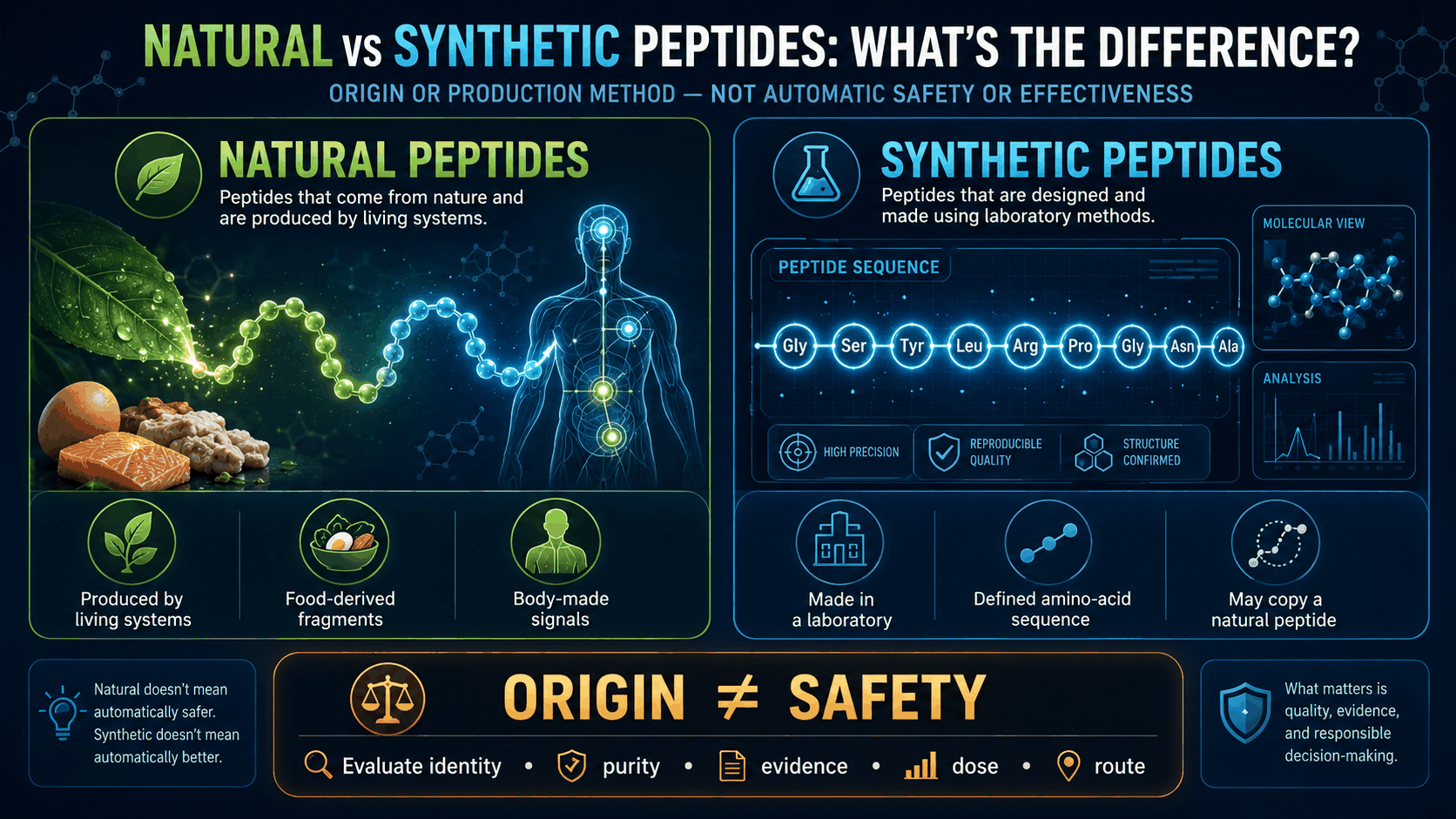
A natural peptide may come from a living system, food protein breakdown, or the human body. A synthetic peptide is made in a laboratory as a defined amino-acid sequence. But the real question is not whether the word sounds friendly or scary. The real question is what the molecule is, how pure it is, how it is used, and what evidence supports it.
What “Natural” and “Synthetic” Actually Mean
Produced by living systems
Natural peptides can be produced by the body or released during digestion or breakdown of proteins.
Produced in a laboratory
Synthetic peptides are manufactured as defined amino-acid sequences. They may copy a natural peptide or be modified for a specific purpose.
Where Peptides Come From
Food-derived fragments
Protein-rich foods are broken down into amino acids and smaller peptide fragments during digestion.
Human physiology
Peptide hormones, neuropeptides, and immune signals are naturally produced inside the body.
Supplements and medicines
Hydrolyzed proteins contain peptide fragments, while laboratory-made products may contain one specific sequence.
 Sponsored / AffiliateApollo Peptide Sciences · Research-focused peptide science and molecular data
Precision vs Breadth
Food-derived peptides usually arrive as a mixture of many fragments. Defined synthetic peptides can be manufactured as one known sequence. Precision does not guarantee effectiveness, but it allows more controlled study and dosing.
Broad mixtures
Usually less specific. Useful for nutrition and general support contexts, but exact active fragments can vary.
Defined sequence
Potentially more targeted and measurable, but quality, evidence, legality, and intended use still matter.
Natural vs Synthetic Peptide Comparison
| Parameter | Natural / Food-Derived | Synthetic |
|---|---|---|
| Origin | Produced by living systems or derived from food proteins | Produced through laboratory synthesis |
| Composition | Often a mixture of many fragments | Usually one defined sequence |
| Specificity | Broad and variable | Potentially more targeted |
| Dose control | Exact active fragments may vary | Can be measured more precisely |
| Evidence | Often based on nutrition and food-protein research | Ranges from well established to experimental |
| Cost | Usually lower | Usually higher |
| Quality risks | Contamination, inconsistent composition, misleading labels | Incorrect identity, impurities, degradation, non-sterile production |
| Best fit | Nutrition and general support | Defined medical, cosmetic, or research applications |
Three Common Misconceptions
Myth #1: Synthetic peptides are automatically foreign and dangerous.
Fact: Biological effects depend on structure, dose, route, purity, and activity — not simply on whether the molecule came from nature or a laboratory.
Myth #2: Food-derived peptides always produce the same effect as a defined synthetic peptide.
Fact: Food-derived mixtures may support general health, but they do not necessarily reproduce the same sequence, concentration, route, or mechanism.
Myth #3: “Natural” must be safer.
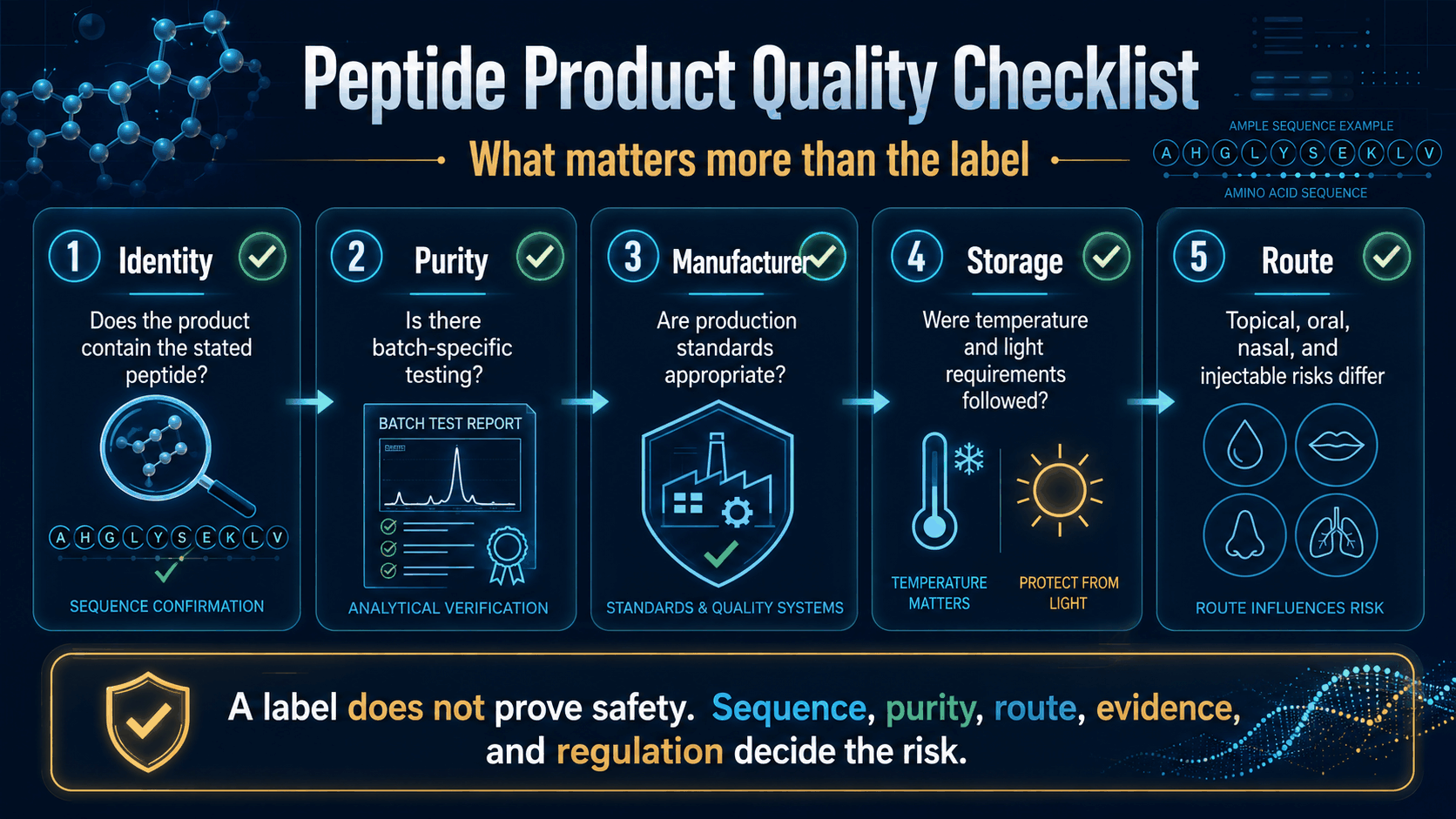
Fact: Natural is not a guarantee of purity, effectiveness, regulation, or safety. Manufacturing quality and evidence matter more.
Safety Checklist: What to Verify
Frequently Asked Questions
Can a synthetic peptide be identical to a natural peptide?
Yes. If the amino-acid sequence and molecular structure are the same, a laboratory-made peptide can be chemically identical to the naturally occurring sequence.
Does synthetic automatically mean pharmaceutical quality?
No. Synthetic only describes how the molecule was produced. Quality depends on manufacturing standards, testing, handling, and intended use.
Are food-derived peptides safer?
They may be familiar as nutritional ingredients, but safety still depends on allergies, contamination, dose, product quality, and individual health conditions.
What matters more than “natural” or “synthetic”?
Identity, purity, dose, evidence, route of administration, legal status, storage, and professional guidance.
 Sponsored / AffiliateUlta Lab Tests · Lab testing for hormones, inflammation, and wellness
Key Takeaways
- Natural and synthetic describe origin or manufacturing method, not automatic safety.
- A synthetic peptide can be chemically identical to a natural sequence.
- Food-derived peptides are often broad mixtures; synthetic peptides may be more defined.
- Identity, purity, evidence, dose, route, storage, and legal status matter most.
- Do not self-prescribe injectable or experimental peptide products.