
Why Storage Rules Are Not Universal
The biggest mistake is assuming every peptide product needs the same temperature.
Some products may require refrigeration. Others are designed for controlled room temperature. Some should not be frozen. Storage depends on formulation, packaging, product category, and official instructions.
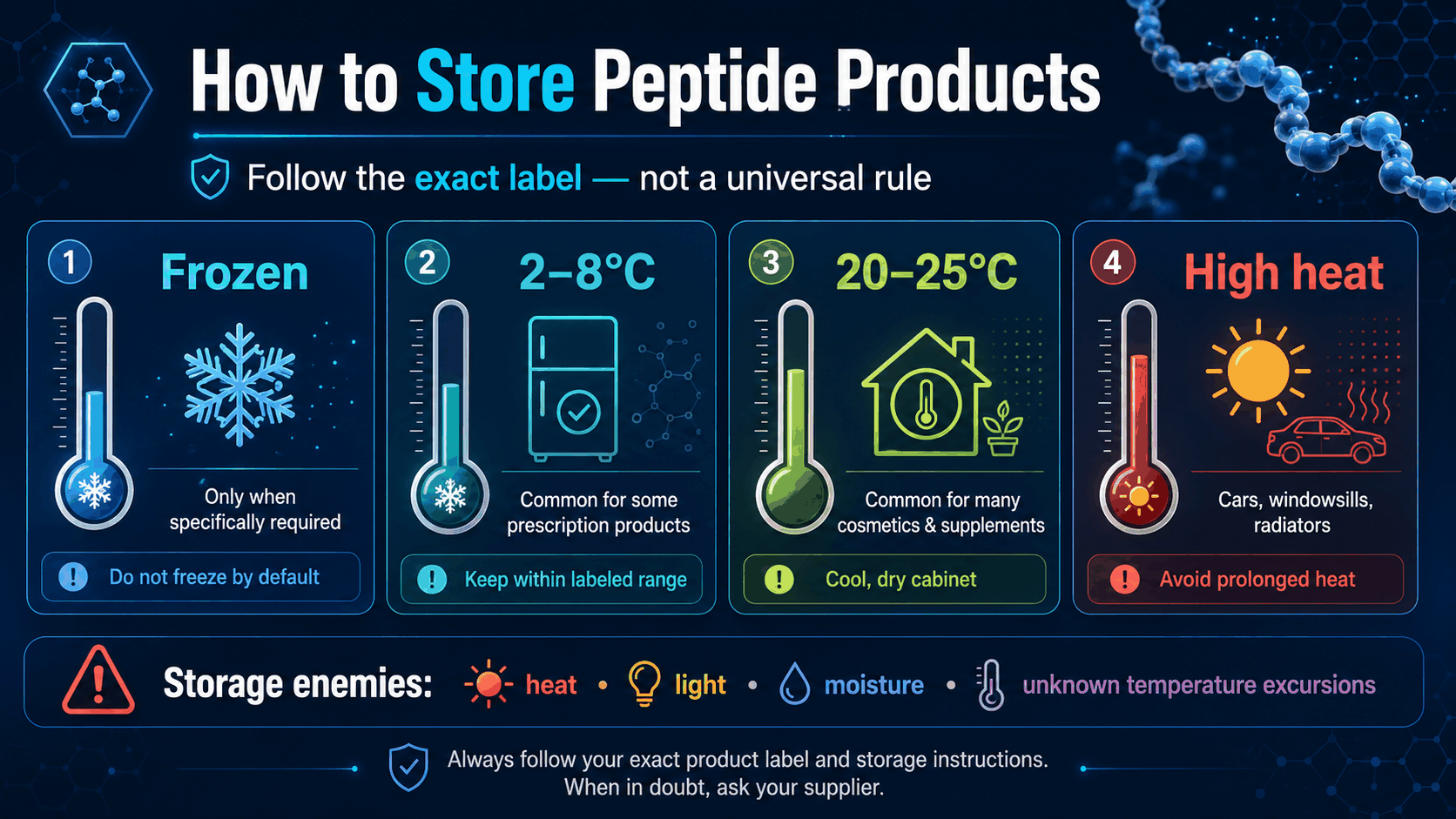
Temperature Guide: Four Practical Zones
Use these zones as orientation only. The official label, pharmacy instructions, or manufacturer guidance remains the source of truth.
Only when required
Use freezing only when the manufacturer specifically permits or requires it.
Cold chain
Common for some prescription peptide medicines and biologic products.
Room temperature
Common for many cosmetics and dietary supplements when label allows.
Avoid
Keep away from parked cars, windowsills, radiators, and prolonged direct sunlight.
Storage Rules by Product Type
| Category | Typical storage source | Main concern | Best practice |
|---|---|---|---|
| Cosmetic peptide serum | Package and brand instructions | Heat, light, air exposure | Use within stated period after opening |
| Collagen / peptide supplement | Nutrition label | Moisture and contamination | Keep dry and tightly closed |
| Prescription peptide medicine | Official label, pharmacy, clinician | Temperature excursions and sterility | Follow product-specific medical instructions |
| Research-only material | Supplier documentation | Unknown suitability for human use | Do not treat it as self-directed medicine |
 Sponsored / AffiliatePeptide ReGenesis · Peptide education, protocols, and wellness-focused resources
Four Rules for Temperature-Sensitive Medicines
When a Product Should Not Be Used
| Sign | What it may mean | Recommended action |
|---|---|---|
| Unexpected cloudiness or particles | Possible instability, contamination, or precipitation | Do not use; contact pharmacy/manufacturer |
| Color change not described in instructions | Possible degradation or formulation change | Stop and verify before use |
| Damaged seal or leakage | Packaging integrity may be compromised | Replace the product |
| Unknown time outside required temperature | Potency or stability may be uncertain | Ask pharmacy/manufacturer |
| Expired or beyond in-use period | Quality can no longer be assured | Discard according to local guidance |
Traveling with Peptide Products
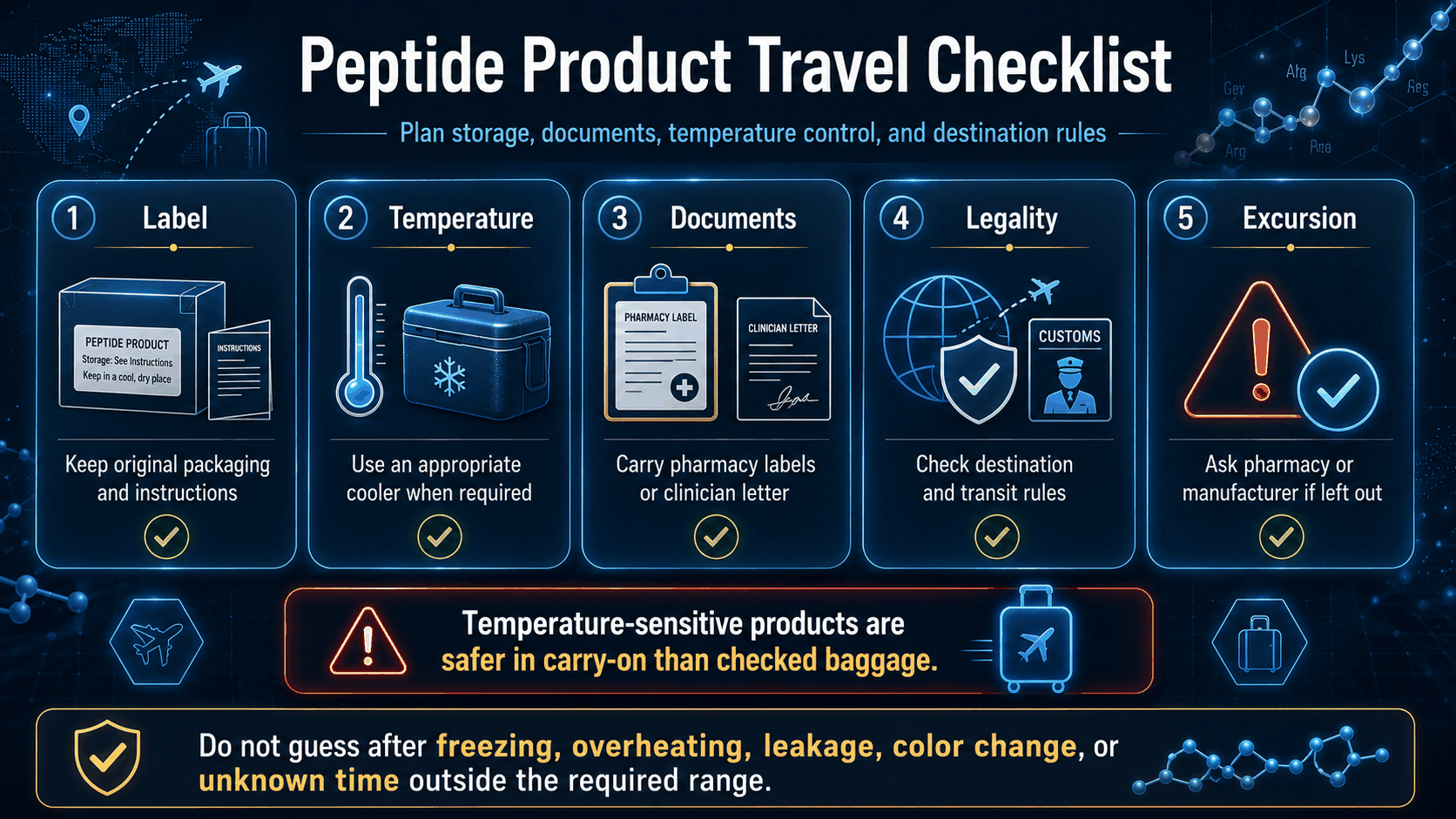
Usually simple
Keep products sealed, protected from heat, and out of direct sunlight. Do not leave them in a parked car.
Plan ahead
Carry original pharmacy labels, documentation, and an appropriate insulated medication case when required.
Verify legality
Check the legal status of the exact product in destination and transit countries before departure.
Frequently Asked Questions
Should all peptide products be refrigerated?
No. Some products require refrigeration, while others should remain at controlled room temperature. Follow the exact label.
Can I freeze a peptide product to make it last longer?
Only when the manufacturer explicitly permits freezing. Freezing can damage some formulations and delivery devices.
What should I do if a medicine was left out overnight?
Do not guess. Check the official instructions and contact the pharmacy or manufacturer with the exact product, temperature, and duration.
Is the bathroom a good place for peptide skincare?
Usually not. Heat and humidity can be higher there. A cool, dry cabinet outside the bathroom is often better.
Can I take refrigerated medicine on a plane?
Often yes, but airline, security, and destination-country rules differ. Carry documentation and use an appropriate medication cooler.
 Sponsored / AffiliateTeleWellnessMD · Telehealth wellness consultations and health optimization support
Key Takeaways
- There is no universal peptide storage temperature.
- Follow the exact label, pharmacy instructions, or manufacturer guidance.
- Heat, light, moisture, and temperature excursions are common storage risks.
- Cosmetics, supplements, prescription medicines, and research-only materials are different categories.
- Do not improvise with reconstitution, injection, or storage periods.