
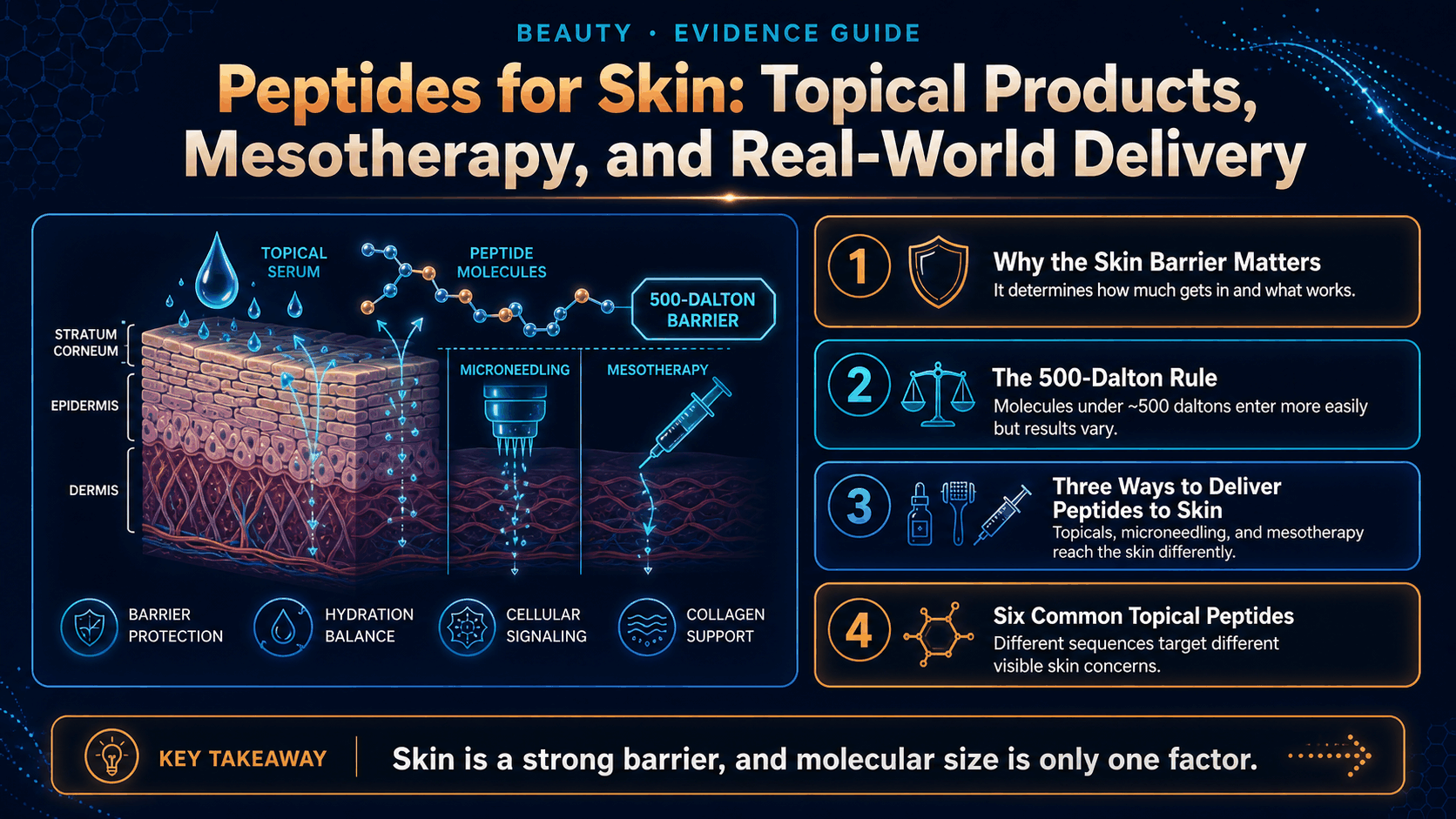
Why the Skin Barrier Matters
The skin is designed to keep substances out.
The stratum corneum limits the movement of many large, charged, or water-soluble molecules. This does not make every peptide cream useless, but it means that cosmetic claims must be interpreted in the context of molecular properties and formulation.
The 500-Dalton Rule
The 500-Da rule is a useful dermatologic formulation principle: molecules above roughly 500 daltons generally have more difficulty crossing intact stratum corneum.
Many cosmetic peptides are larger than 500 Da. Lipid modification, encapsulation, and other delivery systems may improve localization or penetration, but a peptide name alone does not prove dermal delivery.
 Sponsored / AffiliateApollo Peptide Sciences · Research-focused peptide science and molecular data
Three Ways to Deliver Peptides to Skin
Topical Cream or Serum
Usually acts mainly at the surface or upper epidermis. Potential benefits include hydration, smoother texture, barrier support, and antioxidant effects.
Mesotherapy or Injection
Bypasses the stratum corneum, but adds medical-procedure risks and depends heavily on the exact product, sterility, and technique.
Advanced Delivery Systems
Liposomes, niosomes, and nanoemulsions may improve stability or localization. The word “nano” does not prove deep penetration.
Six Common Topical Peptides
 Sponsored / AffiliateTeleWellnessMD · Telehealth wellness consultations and health optimization support
Mesotherapy and Microneedling
Comparing the Methods
| Method | Typical Delivery | Expected Effect | Risk | Setting |
|---|---|---|---|---|
| Basic cream or serum | Surface and upper epidermis | Hydration, barrier support, texture | Usually low | Home |
| Lipopeptide formula | Potentially improved localization | Modest cosmetic improvement | Usually low | Home |
| GHK-Cu formula | Formulation-dependent | Promising but variable | Low to moderate irritation risk | Home |
| Advanced carrier system | May improve stability or delivery | Depends on validated formulation | Usually low | Home / professional |
| Microneedling | Barrier temporarily disrupted | Evidence strongest for needling itself | Moderate | Professional preferred |
| Mesotherapy / intradermal injection | Direct intradermal placement | Product-specific; mixed evidence | Higher and procedure-dependent | Licensed clinic |
Two Common Myths
Myth: Peptides in creams do not work at all.
Fact: Some formulas may improve hydration, texture, or wrinkle appearance. Effects are usually modest and product-specific.
Myth: More peptide names mean a better product.
Fact: The number of peptides does not prove adequate concentration, stability, penetration, or clinical effectiveness.
Frequently Asked Questions
Can peptides reach the dermis from a cream?
Some formulations may improve delivery, but dermal penetration is highly product-specific and cannot be assumed from the ingredient name alone.
Is GHK-Cu the best topical peptide?
It is one of the most studied cosmetic peptides, but “best” depends on formulation, skin tolerance, and the desired outcome.
Is Argireline the same as Botox?
No. Topical Argireline produces much subtler effects and does not work like an injected neuromodulator.
Does mesotherapy work better than a serum?
It bypasses the barrier, but evidence is product-specific and the procedure adds meaningful risks.
Can ordinary serum be used after microneedling?
Not automatically. Products applied to disrupted skin should be sterile and appropriate for the procedure.
Key Takeaways
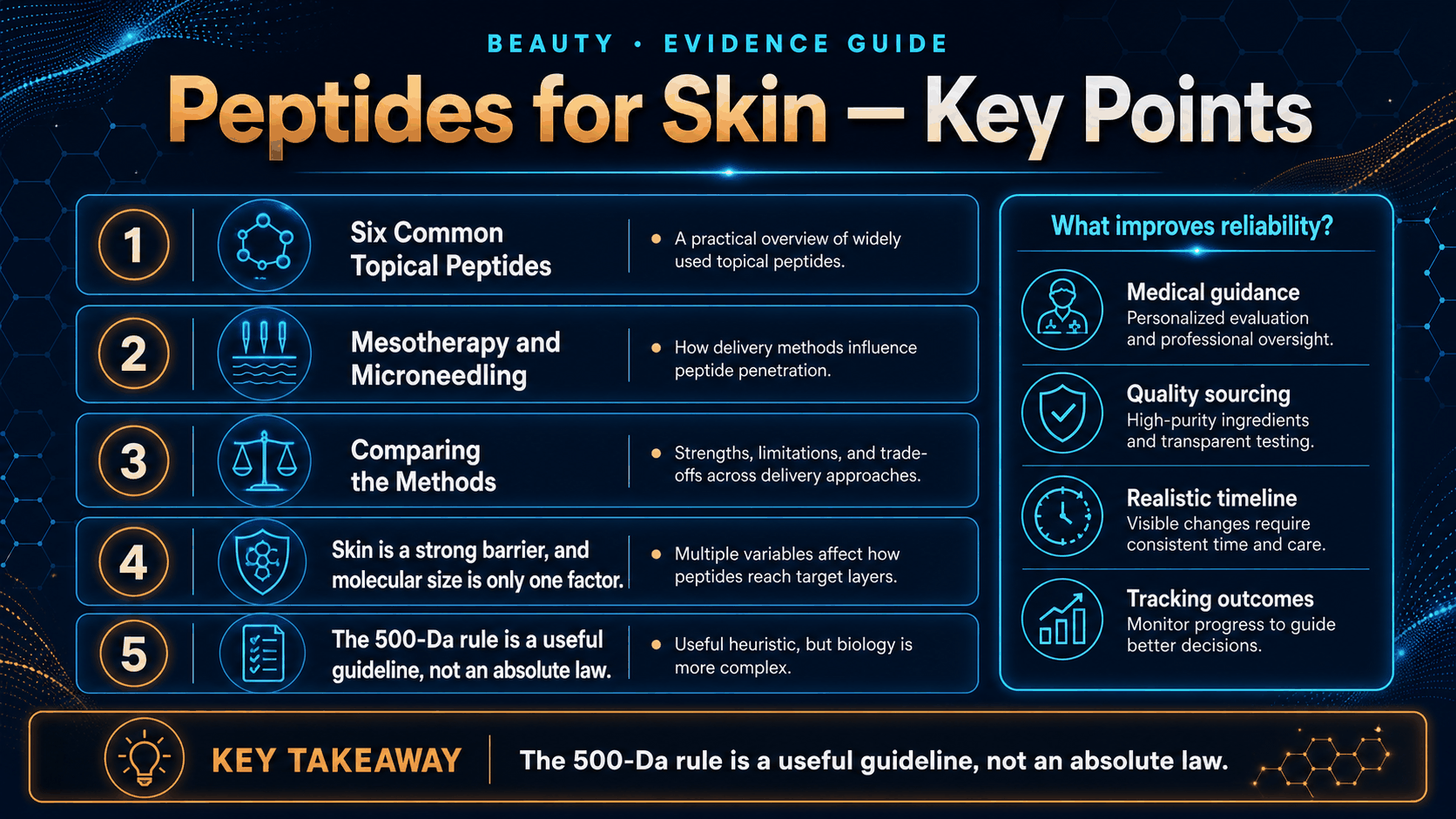
- Skin is a strong barrier, and molecular size is only one factor.
- The 500-Da rule is a useful guideline, not an absolute law.
- Lipid modification and delivery systems may improve performance.
- Topical peptide evidence is product-specific and usually modest.
- Mesotherapy bypasses the barrier but adds procedure-related risks.
- Microneedling should not be paired with ordinary non-sterile serums.
- Sunscreen and established skincare actives remain the foundation.