
Why the Eye Area Needs a Different Approach
The periorbital area is thinner, more mobile, and generally less tolerant of strong or heavy formulas than the cheeks and forehead.
Repeated blinking, smiling, and squinting contribute to expression lines. Fewer sebaceous glands and a thinner barrier can make the area more prone to dryness and irritation. Puffiness and dark circles may also have multiple causes, including fluid retention, pigmentation, visible blood vessels, anatomy, allergies, and sleep.
Four Eye-Area Zones
Upper eyelid
Very thin, highly mobile, and easily irritated. Use only products specifically labeled for the upper lid.
Very delicateLower eyelid
Common concerns include puffiness, dark circles, dryness, and fine lines.
Main treatment areaOuter corner
Crow’s feet are strongly linked to repeated facial movement and sun exposure.
Expression-line focusInner corner
Darkness here may be vascular or structural and is often difficult to change with skincare alone.
Complex concern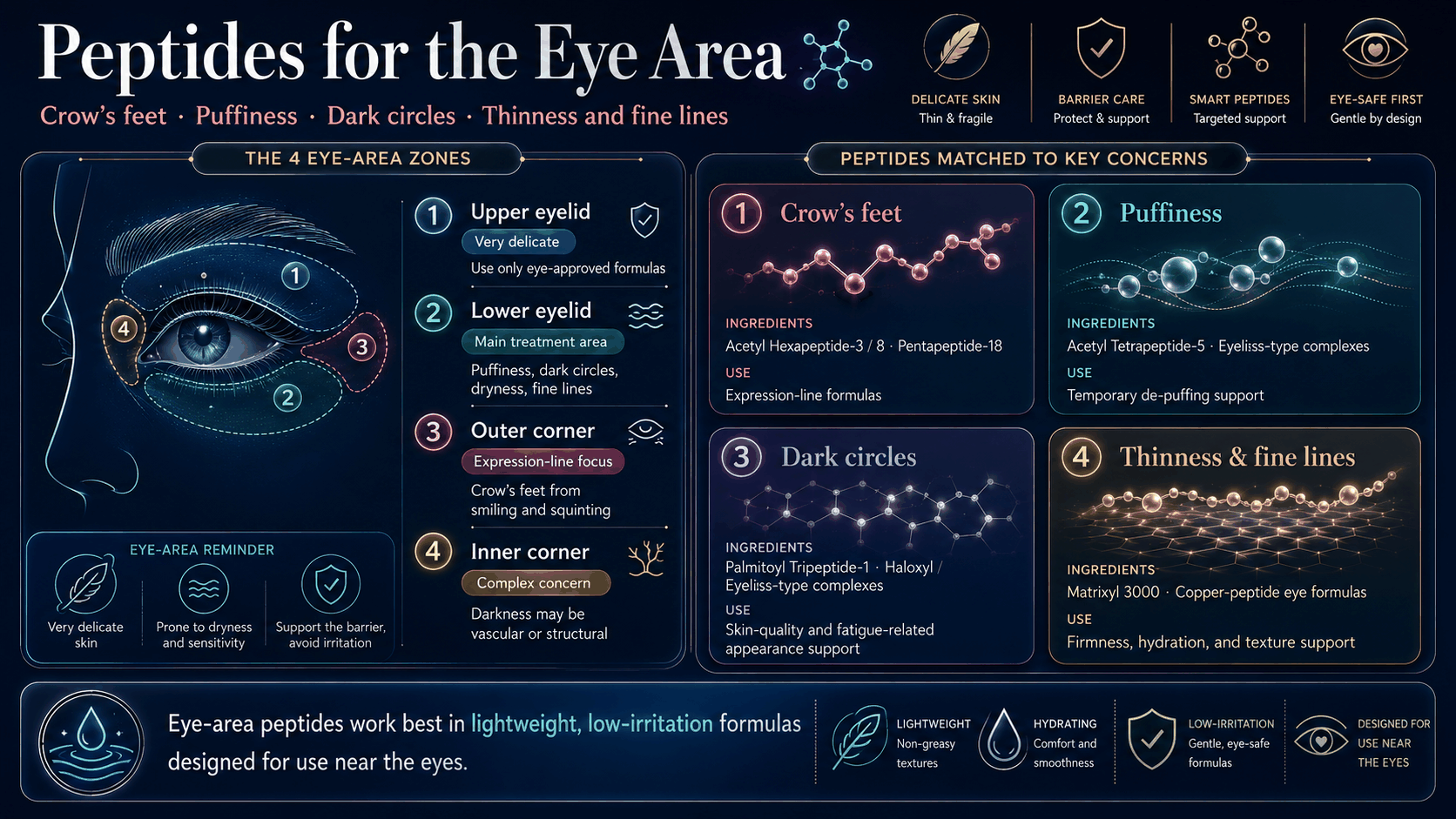
 Sponsored / AffiliateQuest Health · Personal lab testing and health marker tracking
Peptides by Concern
| Concern | Common peptide ingredients | What they are used for | Practical note |
|---|---|---|---|
| Crow’s feet | Acetyl Hexapeptide-3 / -8, Pentapeptide-18, Acetyl Octapeptide-3 | Expression-line formulas designed to reduce the look of repeated movement | Best used in lightweight eye-safe products |
| Puffiness | Acetyl Tetrapeptide-5, Eyeliss-type complexes | Products marketed for temporary de-puffing and fluid-retention concerns | Cooling gels are often more comfortable in the morning |
| Dark circles | Palmitoyl Tripeptide-1, Eyeliss and Haloxyl-type complexes | Support for skin quality and the appearance of vascular or fatigue-related darkness | Results depend heavily on the cause of the dark circles |
| Thinness and fine lines | Palmitoyl Tripeptide-1, Matrixyl 3000, copper-peptide eye formulas | Support for firmness, hydration, and skin-quality appearance | Choose low-irritation formulas made for the eye area |
Which Texture Works Best?
Gel or gel-fluid
Lightweight, fast-absorbing, and well suited to morning use. Cooling formulas may temporarily reduce the look of puffiness.
Best for morningLight emulsion
A balanced evening option that provides moisture without feeling too heavy.
Good all-round choiceRich cream or oil
May suit very dry mature skin, but can migrate, feel uncomfortable, or make puffiness look worse in some people.
Use cautiouslyA Practical Morning and Evening Routine
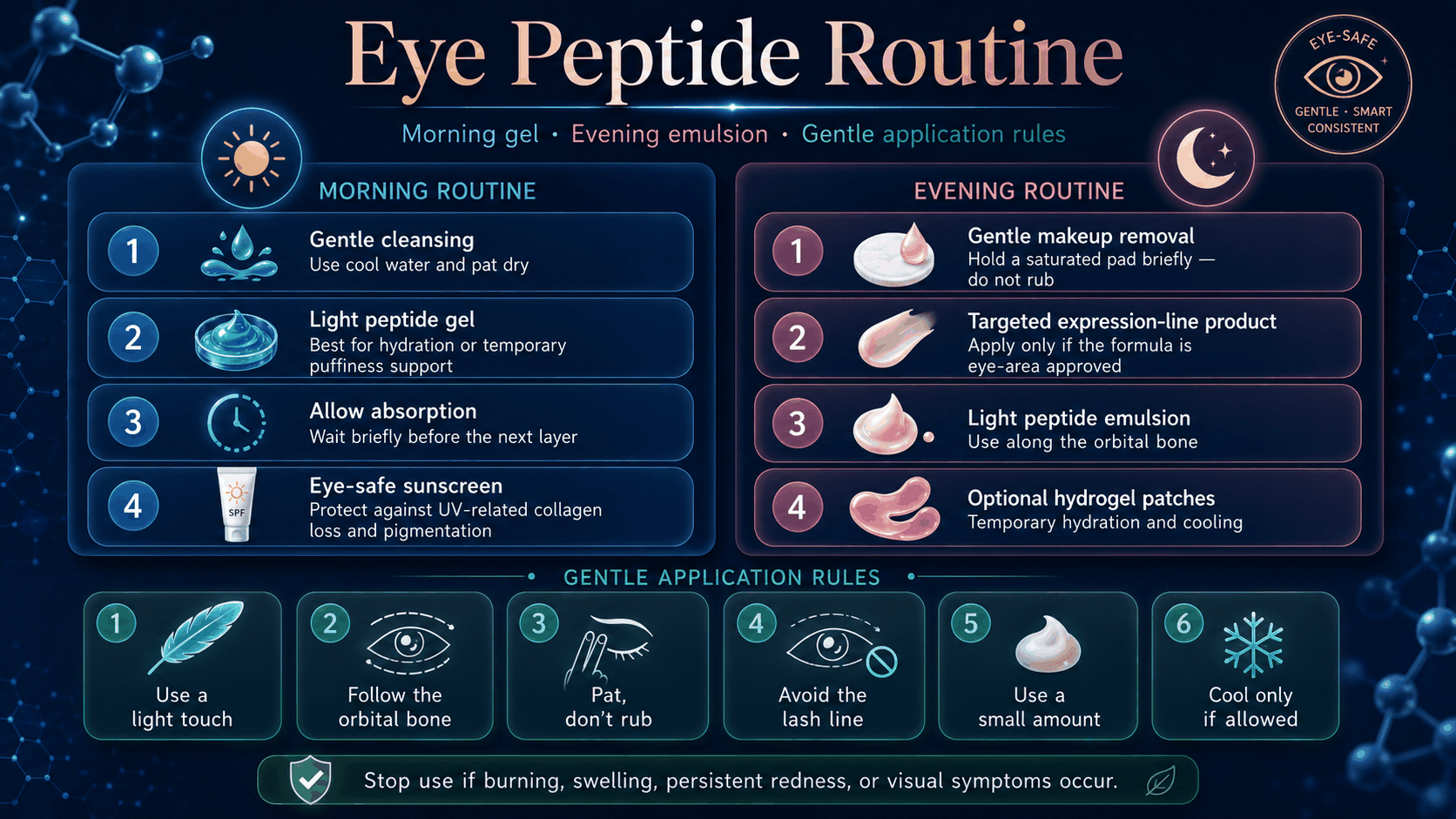
Morning
Use cool water and pat dry without rubbing.
Choose an eye-area formula aimed at puffiness or hydration.
Wait briefly before the next layer.
UV protection is essential for preventing collagen loss and pigmentation.
Evening
Hold a saturated pad briefly instead of rubbing.
Apply to crow’s-feet areas if the formula is designed for eye use.
Use along the orbital bone and avoid the lash line unless the label permits it.
Useful for temporary hydration and cooling.
Six Application Rules
The ring finger can help reduce pressure, but the goal is simply to avoid forceful application.
Apply in small dots and avoid dragging the skin.
Repeated rubbing increases irritation and can stretch delicate skin.
Leave a small margin unless the product is specifically approved for that area.
Extra product can migrate, pill, or increase irritation without improving results.
Refrigerate only when the manufacturer allows it.
What to Use and What to Avoid
Usually helpful
- Lightweight cooling gel
- Eye-safe sunscreen
- Targeted peptide formulas
- Hydrogel patches for temporary hydration
- Gentle tapping and minimal pressure
- Patch testing before regular use
Avoid or use cautiously
- Strong retinoids not formulated for the eye area
- AHA/BHA acids close to the eyelids
- High-strength acidic vitamin C if it stings
- Heavy products that worsen puffiness
- Rubbing or stretching the skin
- Applying too close to the lashes
Two Common Myths
Myth: Eye cream is always just marketing.
Fact: Eye products may use familiar actives, but they are often formulated with lighter textures and lower irritation potential. A regular serum may be suitable only if the label allows use near the eyes.
Myth: Eye patches never do anything.
Fact: Most patches provide temporary hydration and cooling. Some formulas may also offer short-term cosmetic de-puffing, but they do not permanently remove bags or dark circles.
Frequently Asked Questions
Can I use my regular peptide serum under the eyes?
Only when the manufacturer states that it is suitable for the eye area and the formula does not sting, migrate, or feel too heavy.
Which peptide is best for crow’s feet?
Argireline-type peptides are commonly used in expression-line products, but results are usually modest and formulation-dependent.
Can peptides remove dark circles?
They may improve hydration and skin quality, but dark circles have multiple causes. Structural or pigment-related darkness may not respond significantly.
How long should I test an eye peptide product?
Allow several weeks of consistent use unless irritation develops. Take standardized photos to make subtle changes easier to assess.
 Sponsored / AffiliateiHerb · Supplements, wellness products, and daily health essentials
Key Takeaways
- The eye area needs lighter textures and gentler application.
- Use different peptide categories for crow’s feet, puffiness, dark circles, and skin quality.
- Morning routines benefit from cooling gels and sunscreen.
- Evening routines can include targeted expression-line and matrix-support products.
- Avoid rubbing, over-application, and strong actives too close to the eyes.
- Choose finished products formulated and tested for the eye area.