
What Is Matrixyl 3000?
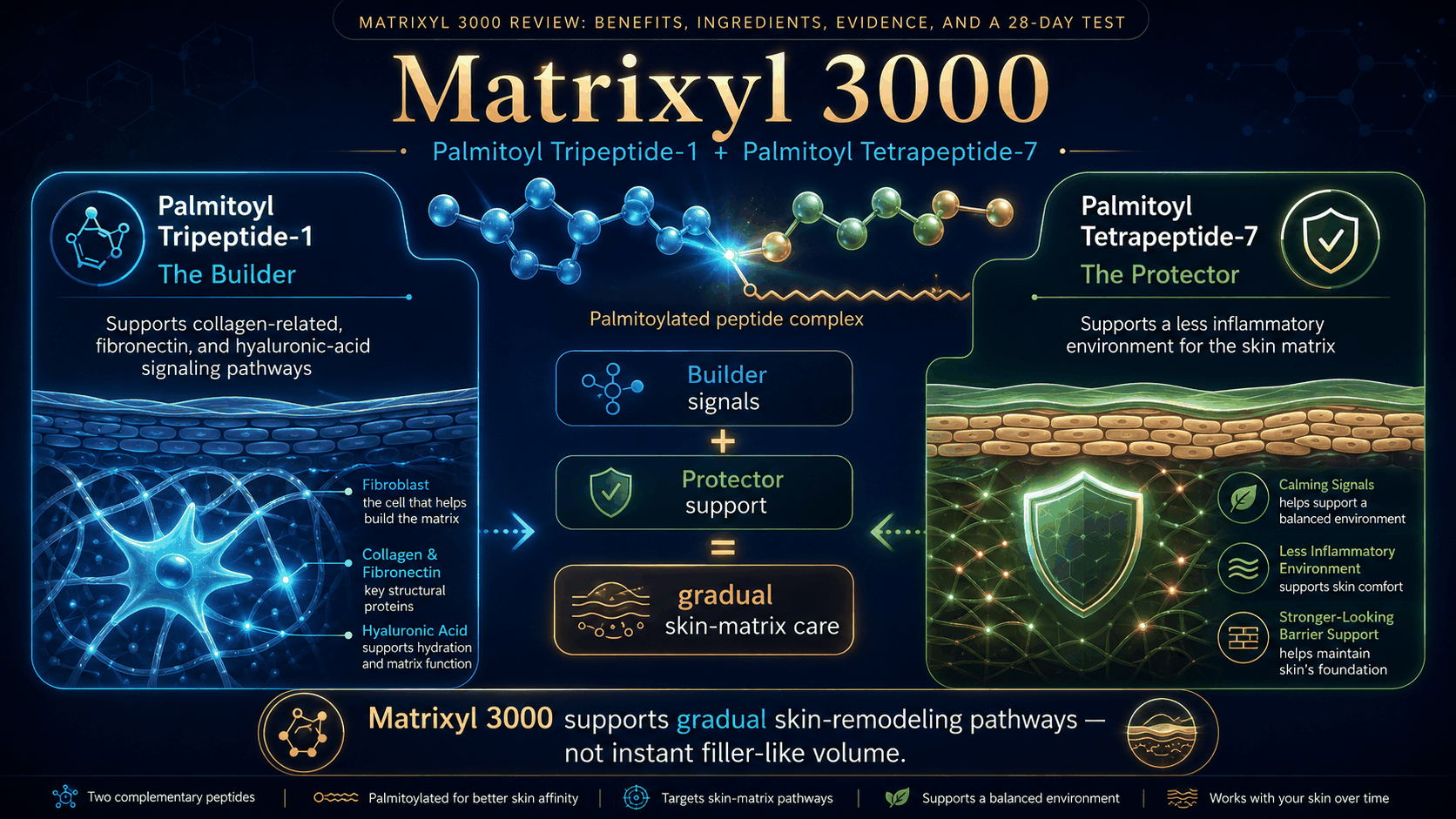
Matrixyl 3000 is a trade name for a two-peptide cosmetic complex.
The two INCI names to look for are Palmitoyl Tripeptide-1 and Palmitoyl Tetrapeptide-7. Both are palmitoylated peptides, meaning they have a lipid-like tail designed to improve their affinity for the skin and formulation environment.
How the Two Peptides Are Intended to Work
The Builder
This peptide is designed to mimic a fragment associated with extracellular-matrix turnover. It may support fibroblast signaling related to collagen, fibronectin, and hyaluronic-acid pathways.
The Protector
This peptide has been studied for possible effects on inflammatory signaling, including pathways associated with IL-6. Its role is often described as helping create a less destructive environment for the skin matrix.
 Sponsored / AffiliateMito Red Light · Red light therapy devices for recovery and wellness routines
A 28-Day Personal Review
The following diary reflects one personal skincare trial, not a controlled clinical study. Lighting, hydration, sleep, camera angle, and natural variation can influence what appears in photographs.
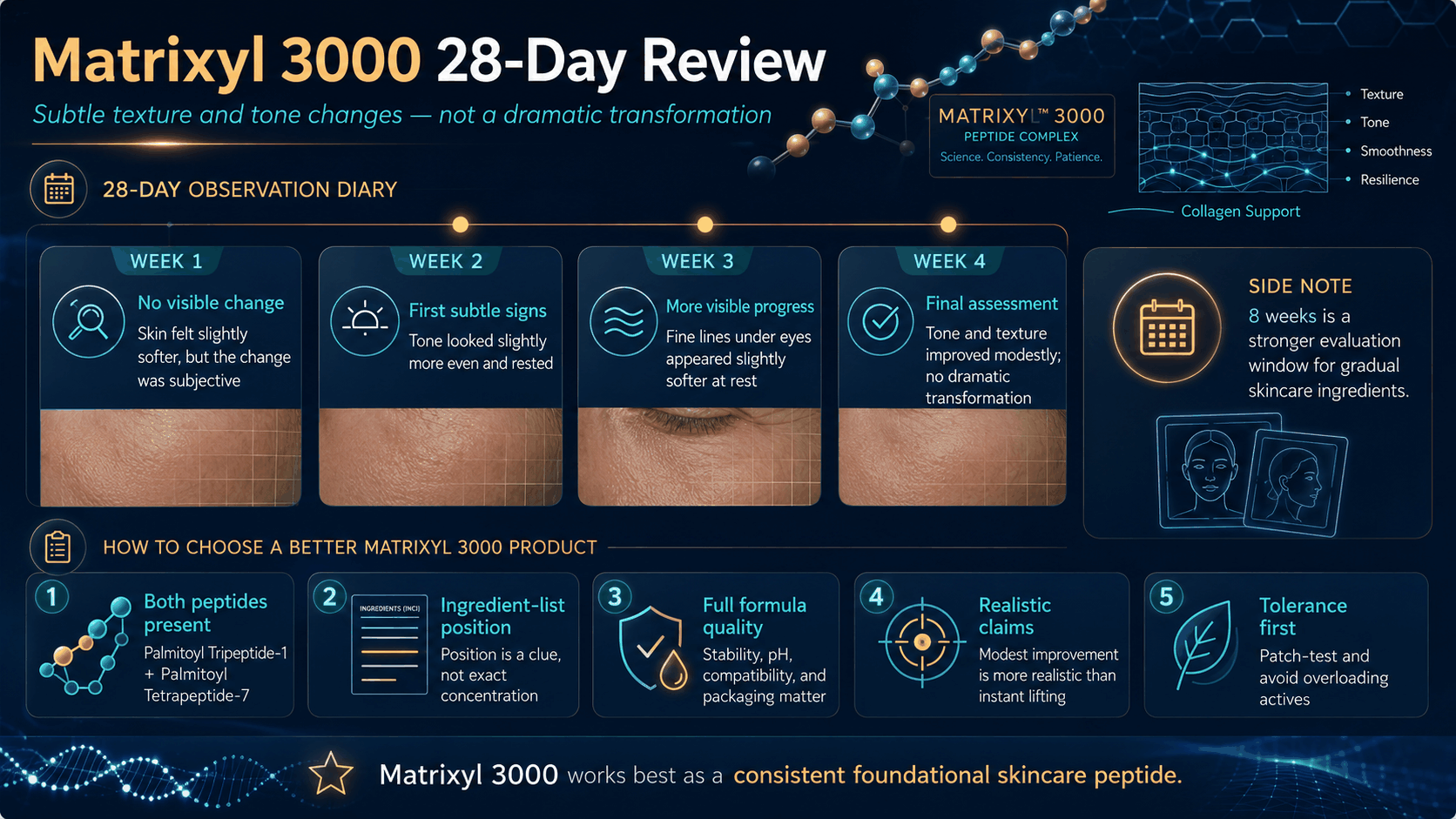
The skin felt slightly softer by the end of the week, but the difference was subjective and could have reflected hydration or placebo.
Around day 11, the skin tone looked slightly more even and rested. The difference was small, but noticeable enough to continue tracking.
Fine lines under the eyes appeared slightly softer at rest. Hydration felt better, and the overall texture looked smoother in side-by-side images.
By day 28, tone looked more even, fine lines appeared modestly softer, and texture looked smoother. There was no dramatic transformation and no noticeable irritation.
What the Evidence Says
| Evidence type | Model | Duration | Main observation |
|---|---|---|---|
| Manufacturer-sponsored cosmetic studies | Small adult cohorts | Several weeks | Reported improvement in wrinkle appearance and texture |
| Double-blind cosmetic evaluation | Adult volunteers | About two months | Reported improvement in firmness and overall appearance versus placebo |
| Laboratory data | In vitro | — | Support for collagen-related and inflammatory-signaling mechanisms |
| Independent small studies | Small samples | About four weeks | More modest texture changes and limited statistical certainty |
Matrixyl 3000 vs GHK-Cu
Matrixyl 3000
- Supports matrix-signaling and inflammatory pathways
- Well suited to daily foundational skincare
- Often more affordable
- Typical evaluation window: four to eight weeks
GHK-Cu
- Copper-binding peptide linked to repair pathways
- Often used in more intensive recovery-focused routines
- Usually more expensive
- Typical evaluation window: six to twelve weeks
How to Choose a Matrixyl 3000 Product
The full complex should include Palmitoyl Tripeptide-1 and Palmitoyl Tetrapeptide-7.
Position is only a rough clue, but both peptides at the very end of the list may indicate a very small amount.
Stability, packaging, pH, compatibility, and manufacturer transparency matter more than a large percentage printed on the front label.
Two Common Matrixyl 3000 Myths
Myth: Matrixyl 3000 works like an injectable filler.
Fact: It supports gradual skin-remodeling pathways. Injectable fillers add immediate volume. These are different mechanisms and timelines.
Myth: A higher percentage always means better results.
Fact: Peptides work as signals, and finished-product percentages may refer to a supplier solution rather than pure peptide content. Formula quality matters more than a headline number.
Frequently Asked Questions
How long does Matrixyl 3000 take to work?
Some users may notice subtle changes after four weeks, but eight weeks is a more useful evaluation period.
Can Matrixyl 3000 replace retinoids?
No. They have different mechanisms and evidence. Some routines use both, depending on tolerance.
Can it be used with GHK-Cu?
Often yes, but product compatibility and skin tolerance should guide the routine.
Is a 5% Matrixyl serum necessarily strong?
Not necessarily. The number may refer to a supplier blend rather than pure active peptide content.
 Sponsored / AffiliateDynamic Peptides · Research peptide catalog and product education resources
Key Takeaways
- Matrixyl 3000 combines Palmitoyl Tripeptide-1 and Palmitoyl Tetrapeptide-7.
- One peptide supports rebuilding signals; the other supports a less destructive environment.
- Four weeks may reveal subtle changes, while eight weeks offers a stronger test window.
- Manufacturer-sponsored research is more optimistic than independent evidence.
- Look for both peptides and evaluate the full formula, not only the marketing percentage.
- Matrixyl 3000 and GHK-Cu can complement each other in a well-tolerated routine.