
What Each Active Does
The three ingredients are not identical, and they do not need to be used in the same way.
Peptides
Signaling ingredients used to support collagen-related pathways, repair, hydration, firmness, or inflammatory balance. Stability depends on the specific peptide and finished formula.
Retinol
A vitamin A derivative that supports cell turnover, collagen-related pathways, and more even pigmentation. It is effective but can be irritating.
Vitamin C
An antioxidant used for collagen support and uneven pigmentation. Pure L-ascorbic acid is acidic, while derivatives may be stable at a higher pH.
Why pH Matters
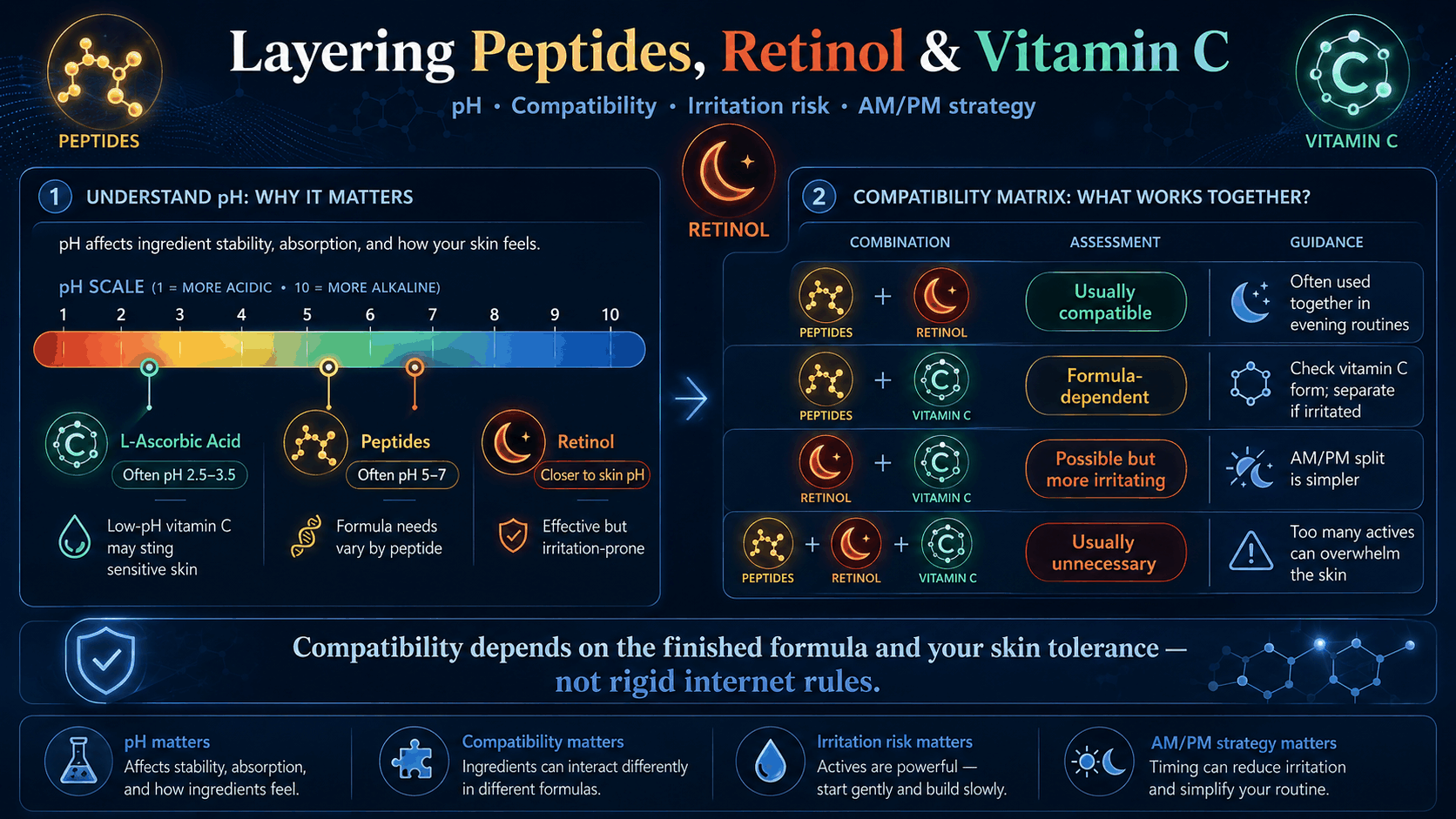
Pure L-ascorbic acid is commonly formulated at a low pH, while many peptide and retinol products are closer to the skin’s natural pH. That difference does not mean the ingredients automatically destroy one another, but it can affect tolerance and formula stability.
 Sponsored / AffiliatePeptide ReGenesis · Peptide education, protocols, and wellness-focused resources
Compatibility Matrix
| Combination | Assessment | Practical guidance |
|---|---|---|
| Peptides + Retinol | Usually compatible | Often used together in evening routines. Introduce retinol slowly. |
| Peptides + Vitamin C | Formula-dependent | Check the vitamin C form. Separate if a low-pH serum irritates the skin. |
| Retinol + Vitamin C | Possible but more irritating | An AM/PM split is simpler and easier to tolerate. |
| All three together | Usually unnecessary | Complex routines increase irritation and make reactions harder to identify. |
Morning and Evening Layering Routines
Morning
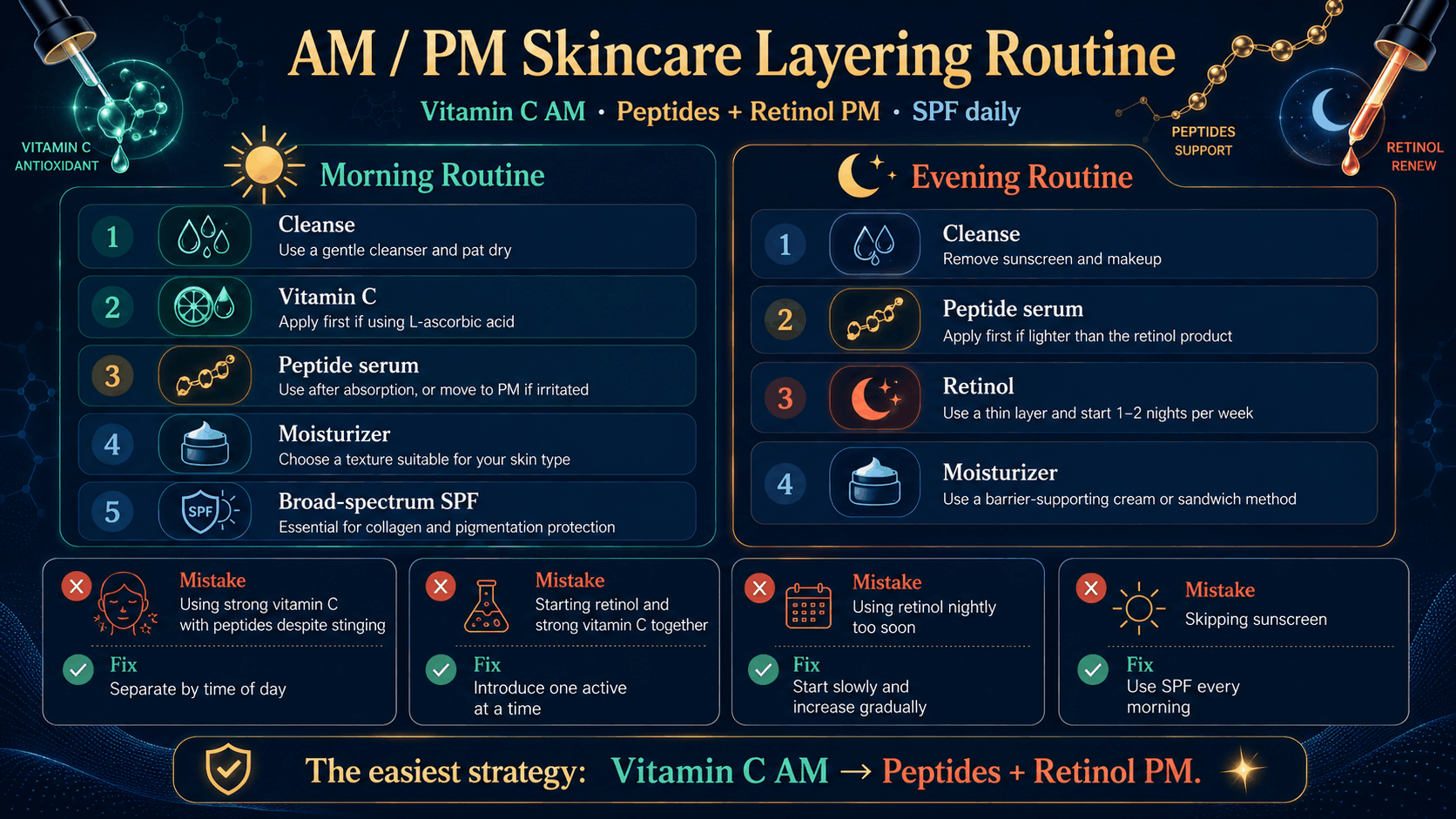
Use a gentle cleanser and pat the skin dry.
Apply first on clean, dry skin if using L-ascorbic acid.
Apply after vitamin C has absorbed, or move peptides to the evening if the combination irritates.
Choose a texture suitable for your skin type.
Essential for protecting collagen and preventing pigmentation.
Evening
Remove sunscreen and makeup, then let the skin dry fully.
Apply first if the texture is lighter than the retinol product.
Use a thin layer and begin one or two nights per week.
Use a richer cream or the moisturizer–retinol–moisturizer sandwich method.
How Long Should You Wait Between Layers?
Long waiting periods are usually unnecessary unless a product specifically requires them or your skin becomes irritated. Waiting until each layer feels absorbed is often enough.
| Combination | Suggested approach | Reason | Assessment |
|---|---|---|---|
| Vitamin C → Peptides | Wait until absorbed; separate sessions if sensitive | Very acidic formulas may sting or affect peptide stability | Formula-dependent |
| Peptides → Retinol | Apply after the peptide layer dries | Usually compatible; texture order matters | Common routine |
| Retinol → Peptides | Possible, but less practical | Thinner products usually go first | Acceptable |
| Vitamin C + Retinol | AM/PM split is simplest | The main concern is irritation | Advanced routine |
| All three | Use only if the formulas are compatible | Too many actives can overwhelm the skin | Usually unnecessary |
Four Common Mistakes
Using strong L-ascorbic acid and peptides together despite stinging.
Separate them by time of day or choose a vitamin C derivative.
Starting retinol and strong vitamin C at the same time.
Introduce one active at a time and use an AM/PM split.
Using retinol every night on dry or irritated skin.
Start one or two nights per week and increase gradually.
Using active skincare without daily sunscreen.
Use broad-spectrum SPF every morning.
Two Common Myths
Myth: A product containing peptides and vitamin C must be ineffective.
Fact: Not necessarily. Manufacturers may use vitamin C derivatives, encapsulation, or carefully designed delivery systems. Judge the finished formula, not a simplified ingredient chart.
Myth: Peptides and retinol should never be used together.
Fact: This combination is usually compatible. Peptide formulas may add hydration and barrier support to a retinol routine. Tolerance matters more than a proven biochemical conflict.
Frequently Asked Questions
Can I use peptides and retinol in the same routine?
Usually yes. Apply according to texture and product directions, and introduce retinol gradually.
Can I use vitamin C and peptides together?
Often yes, especially when the vitamin C is a derivative. Very acidic L-ascorbic-acid formulas may be better separated if irritation occurs.
Do I need to wait 20–30 minutes between layers?
Usually not. Waiting until the previous layer is absorbed is often sufficient unless the manufacturer says otherwise.
Which active should I introduce first?
Introduce one product at a time. For sensitive skin, begin with peptides, then add vitamin C or retinol gradually.
 Sponsored / AffiliateiHerb · Supplements, wellness products, and daily health essentials
Key Takeaways
- Vitamin C is usually simplest in the morning.
- Retinol is usually simplest in the evening.
- Peptides can often be used in either routine.
- Very acidic vitamin C may be separated from peptides if irritation occurs.
- Peptides and retinol are usually compatible.
- Daily broad-spectrum sunscreen is essential.